
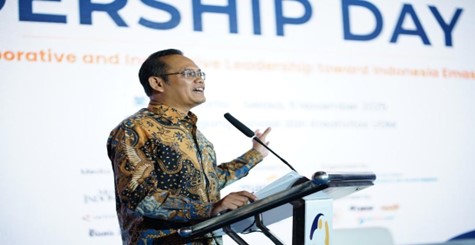
Yogyakarta, 11th November 2025 — Leadership Day 2025, organized by the Graduate School of Universitas Gadjah Mada (SPs UGM) through the Leadership and Policy Innovation (MDKIK) Master and Doctoral Program, together with the Alumni Association of the Master’s and Doctoral Program in Leadership and Policy Innovation (Kapimgama), opened meaningfully with a keynote speech titled “The Foundation of Interdisciplinary Leadership” delivered by Prof. Dr. Ahmad Najib Burhani, M.A., Director General of Science and Technology, Ministry of Education, Culture, Research, and Technology (Kemendikstiristek).
This session served as a moment of reflection on the interdisciplinary importance’s approaches in building future leadership rooted in humanity and collaboration.
Prof. Najib, in his presentation, emphasized that UGM must continue to be a pioneer of interdisciplinary education as a foundation for nurturing the leaders capability to connect various fields of knowledge. “Bridging disciplines, building the future — this is the essence of true leadership,” he said.
He illustrated how the COVID-19 pandemic became a clear example that major global issues cannot be solved by a single discipline alone. “During the pandemic, collaboration among health, religion, politics, and even the military was a necessity. This reflects that inter-, multi-, and transdisciplinary approaches are no longer optional but inevitable,” he added.
According to Prof. Najib, policies and technologies developed by the government should also be grounded in a human-centered approach — placing people, culture, and social values at the core of innovation. He highlighted that technology devoid of humanity would only lead to progress without meaning.
“Technology without ethics, social justice, and sustainability loses its human soul. We must integrate cultural dimensions and local values into every policy so that development truly serves humanity,” he explained. In this context, he cited the example of development in Papua, which, he argued, cannot be understood merely from a technocratic standpoint but must also consider the social, cultural, and character aspects of local communities. “Diversity and local wisdom are not obstacles to progress; they are foundations enriching national development,” he affirmed.
Prof. Najib also discussed the concepts of co-creation, co-design, and citizen science as forms of public engagement in innovation processes. He stressed the importance of building social trust as the main capital in any development effort. “Social trust is the heart of every transformation. Without it, science and technology will only become elitist projects disconnected from societal realities,” he remarked.
Concluding his session, Prof. Najib reminded the audience of future challenges — such as climate change, digital technology, and demographic shifts — demand leadership that transcends disciplinary boundaries. “The question is no longer whether technology will replace humans, but how to design technology that strengthens humanity,” he concluded.
Reflecting the spirit of Leadership Day 2025, this session reaffirmed the university’s role as a kawah candradimuka (a crucible of transformation) for the emergence of future leaders — leaders who think across disciplines, act collaboratively, and are guided by humanity. From the UGM campus, the spirit of interdisciplinary leadership is reignited to guide Indonesia’s journey toward Golden Indonesia 2045.
Writers: Naufal Sabda Auliya and Rosyida Indah Mawarni
Editor: Arfikah Istari