
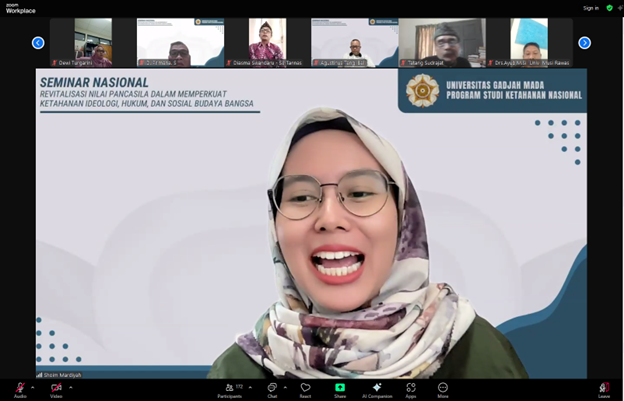
The Master’s and Doctoral Programs in National Resilience, Graduate School of Universitas Gadjah Mada (UGM), held a national seminar entitled “Revitalization of Pancasila Values in Strengthening the Nation’s Ideological, Legal, and Socio-Cultural Resilience” on Thursday (June 19th). The event was conducted online via the Zoom Meeting platform and broadcast live through the YouTube channel, attended by more than 200 participants from various backgrounds, including students, academics, practitioners, and representatives from the Indonesian Military Academies (Army, Navy, Air Force) as well as the Police Academy.
The seminar aimed to reflect on the current state of Indonesia’s ideology, law, and socio-cultural conditions, while formulating strategic steps to strengthen national resilience toward a better future.
The Chief of National Resilience Master and Doctoral Program at UGM, Prof. Dr. Armaidy Armawi, M.Si., in his remark, invited all participants to use the momentum of Pancasila Month as an appropriate time to reconsider the fundamental values of the nation.
“The Pancasila Month, commemorated every June 1st as the birth of Pancasila, let us remember and reflect on Pancasila once again. Currently, we are facing human resource issues that compel us to ponder: does the character of our nation today truly reflect the character of Indonesia?” said Prof. Armaidy. He also emphasized the importance of loving Indonesia as the result of the hard work of the nation’s heroes and the commitment in maintaining and strengthening national unity.
The seminar featured two main speakers: Prof. Yudi Latif, Ph.D., former Chief of the Agency for Pancasila Ideology Education (BPIP), and Prof. Dr. Heddy Shri Ahimsa-Putra, M.A., M.Phil., Professor of Anthropology at UGM. Both highlighted the importance of revitalizing Pancasila values in facing various national challenges in the era of globalization, from ideological, legal, and socio-cultural perspectives.
Prof. Yudi, in his presentation, stressed that Pancasila must be deeply understood to fulfill its function as a coherent ideological system that provides a foundation for action across all aspects of life.
Meanwhile, Prof. Heddy added that Pancasila can serve as a bridge between philosophy and worldview. He emphasized that within the framework of nationhood and statehood, Pancasila still needs to be translated into a more operational set of concepts to be effectively applied in everyday life.
The participants concluded the importance of strengthening Pancasila values from an early age, both through formal education and other media, in accordance with educational levels. Thus, the abstract values of Pancasila can be properly understood and effectively implemented in national and state life.
Author: Asti Rahmaningrum