
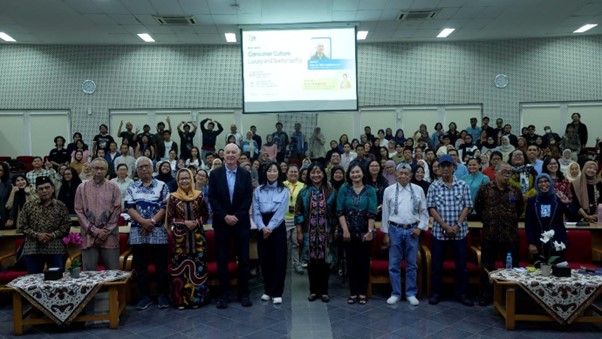
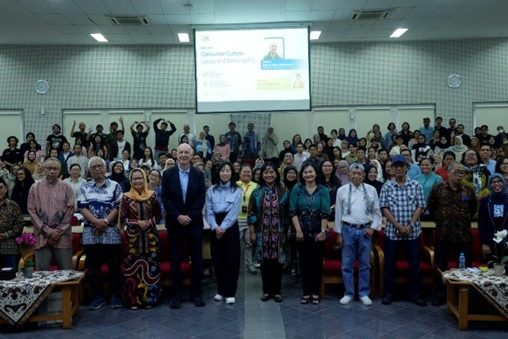
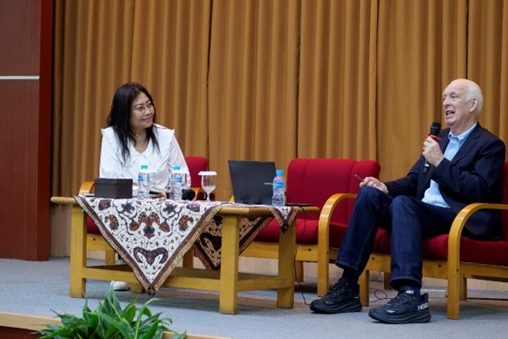
Yogyakarta, 6 November 2025 — The Graduate School of Universitas Gadjah Mada held a public lecture titled “Consumer Culture: Luxury and Sustainability” featuring Prof. Dr. Mike Featherstone from Goldsmiths, University of London. The event took place at the 5th-floor Auditorium from 08.30 to 12.00 WIB, moderated by Dr. Suzie Handajani, M.A. (Lecturer in Media and Cultural Studies & Department of Anthropology, UGM).
In his presentation, Prof. Featherstone traced the long history of luxury—from something once seen as dangerous and regulated through sumptuary laws, into a cornerstone of global consumer culture. He revisited the classical debate between Max Weber, who viewed Protestant ethics as rejecting luxury, and Werner Sombart, who saw aristocratic consumption as a driving force behind the rise of modern capitalism.
Featherstone then highlighted the “democratization of luxury” since the 19th century: the emergence of department stores, hotels, and cinemas that produced glamorous imagery and made “little luxuries” seemingly accessible everywhere. However, this apparent accessibility runs parallel with growing inequality—data and visuals reveal how wealth accumulation has increasingly concentrated among the global super-rich.
This phenomenon, he argued, marks a kind of “refeudalization”: the lifestyles of the super-wealthy—from superyachts to private jets—now serve as new symbolic standards beyond public reach. At the same time, the planetary consequences of overconsumption have become increasingly visible, from overtourism protests to the climate crisis.
Can luxury be sustainable? Featherstone examined claims on durability, quality, and investment value in luxury goods while cautioning against the rapid turnover of “masstige” (mass prestige) products that accelerate consumption cycles. He also critiqued the proliferation of carbon rating agencies and carbon credit markets prone to greenwashing, while noting regulatory initiatives such as the EU Digital Product Passport aiming to ensure material traceability and environmental accountability.
Featherstone, in the future will emphasize the emergence of a new consumer ethics—post-consumerism, degrowth, and a shift from ownership to experience, care, and repair. He referenced practices such as “buy less, choose well, and make it last” and introduced aesthetic paradigms like wabi-sabi—the appreciation of simplicity and impermanence—and kintsugi as a metaphor for repair and longevity. In his concluding section, “Beyond Luxury”, he invited the audience to consider the idea of immaterial luxury: sensitivity, meaning, and non-material values that honor attention, empathy, and time.
Prof. Featherstone asserted in the closing that the future of luxury is not about having more, but about enjoying more wisely—aligned with the demands of social justice and the ecological limits of the planet. The lecture enriched interdisciplinary discourse at UGM’s Graduate School and encouraged the academic community to engage critically in fostering more transparent and sustainable modes of production, consumption, and public policy.
Author: Khoirul Mujazanah