
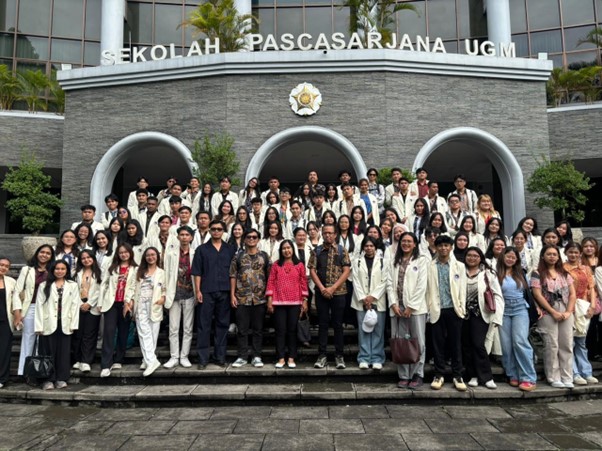
UGM’s Peace and Conflict Resolution Interest Program (MPRK) received a study visit from Satya Wacana Christian University (UKSW) Salatiga in the Graduate School auditorium on Tuesday (December 9th). The event included 90 students, aiming to study the disciplines of peace and conflict as taught by the MPRK. UKSW itself has an undergraduate program in International Relations, which is relevant to the academic disciplines at the MPRK.
The UGM MPRK, on this occasion, was represented by Mohtar Masoed, Chief of Study Interest, and guided by Dody Wibowo, Chief of Quality Assurance. Mohtar introduced the development of International Relations (IR) and its history. The development’s direction Mohtar explained was the emergence of non-traditional security as a result of World Wars I and II. He explained that IR is a multidisciplinary discipline, one of which encompasses the study of peace and conflict resolution, within the discourse of human security. The aspect of human security is an integral part of peace and conflict studies.
“Security issues initially tended to be resolved by the military, but over time, many security aspects can be addressed by non-military actors. Therefore, the multidisciplinary nature of International Relations (IR) allows students to assess legal, economic, and social aspects,” said Mohtar.
Mohtar also explained that IR prepares graduates for diplomatic careers and addresses human security at other levels. He believes that the similarity in the curriculum for human security courses can be developed by UKSW and the MPRK UGM, a potential avenue for collaboration.
Kris, a lecturer in the IR department at UKSW, represented UKSW. He stated that the visit, which included a public lecture, taught UKSW IR students to be more discern and thorough in examining issues more closely. The discourse on human security, as presented by Mohtar, can hone their sensitivity and analysis of local issues before viewing them from afar (internationally).
“Before we look at problems from far away (internationally), it turns out there are issues close by that we can experience firsthand. So, this discourse is extraordinary for sharpening our sensitivity,” said Kris.
Glory Prayoga also present on the occasion, a lecturer at International Relations at UKSW and an alumnus of the MPRK UGM. According to him, the human security situation, when analyzed in terms of the problems in Salatiga City, falls into the category of structural violence. Over the years, a sense of acceptance of the existing structural violence has developed. “Generally, if we look at it from an economic, environmental, and health perspective, Pancoran Village falls into the vulnerable group. And it’s been an issue for years, so it’s become a habit (cultural violence),” Yoga explained.
The session then concluded with a response from Titik Firawati, a lecturer at MPRK UGM. She stated that the concept of security in the human security dimension can be explained through the case of India in the 1980s, when the Indian government opened its economy, marking the beginning of the global capitalist regime. This influenced lifestyle demands through wedding dowries. “In this context, security in the study of non-war peace can help us understand how the definition and concept of security are perceived,” he concluded.
Author: Dimas Adi Nugroho
Editor: Burhanul Aqil