
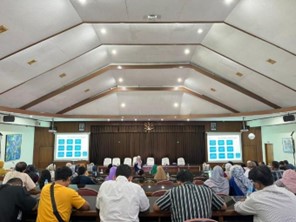
Universitas Gadjah Mada (UGM), with the Halal Center, held a Socialization of Laws and Regulations on Halal Product Assurance on Wednesday, 19 November 2025 at the 3rd Floor Auditorium of the MD Building, Faculty of Economics and Business (FEB) UGM.
This activity presented a speaker, Ir. H. Nanung Danar Dono, S.Pt., M.P., Ph.D, as Deputy Chair of the UGM Halal Center as well as Chief of the Islamic Economics (Ekis) Study Interest from the Religious and Cross-Cultural Studies Program of the Graduate School, Universitas Negeri Malang (UM), who explained the importance of halal certification as a guarantee of products that are safe and trusted by Muslim consumers around the world.
Nanung, in his presentation, conveyed that halal certificates have great urgency considering that the world’s Muslim population has reached 2 billion people. This becomes a highly promising global market potential for business practitioner. Not only in Muslim-majority countries such as Indonesia, halal demand and awareness are also rapidly developing in various countries such as Japan, South Korea, Canada, and even European regions that routinely hold Halal Expos. “Halal does not belong only to Muslims or Indonesia, but has become an international standard,” he said.
Nanung also explained the transformation of the halal logo as a form of security and comfort assurance for consumers. Currently, there are 93 halal institutions in the world, and this number is predicted to continue increasing. He emphasized that every imported product must meet halal standards and go through the Mutual Multilateral Recognition Agreement (MMRA) system. Besides that, business actors are encouraged to improve product quality, enhance packaging, and broad increasing advantages on halal market opportunities.
Nanung also educated participants on how to identify non-halal food ingredients as well as the importance of ensuring that processing procedures are free from contamination. He highlighted several matters that must be considered in halal certification, starting from clarity of meat sources (not carcasses or prohibited animals), hygiene of processing equipment, and the use of additives such as alcohol and mirin which are prohibited. Even supporting tools such as cooking brushes must be ensured not to be made from pig bristles, noting that Indonesia once imported boar bristles in 2001.
At the end of the session, Nanung expressed his hope that UGM can become a pioneer campus facilitating independent halal certification for its academic community and business actors within the campus environment. “We want UGM to become the first campus to provide halal certification services, so that students and assisted MSMEs can level up and be increasingly ready to compete in the global halal market,” he concluded.
This activity aligns with the implementation of SDG 4 on quality education, SDG 12 on responsible consumption and production, and SDG 17 on partnerships to achieve the goals.
Writer: Heni
Editor: Arni