

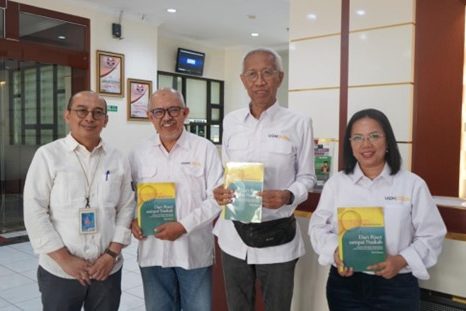
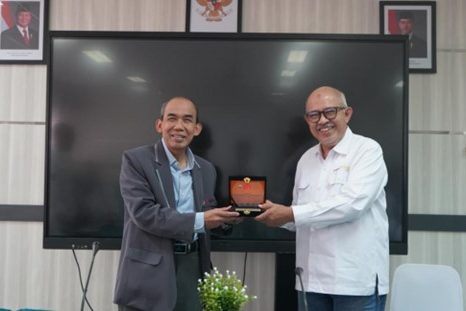
Yogyakarta, July 2nd 2025 – Synergy among academia, industry, and regulators is considered a key factor in enhancing the quality and sustainability of higher education in Indonesia. This is a significant conclusion drawn from the study visits by the Master of Higher Education Management (MMPT) program of Universitas Gadjah Mada (UGM) to the Higher Education Service Institution (LLDIKTI) Region IV of West Java and Banten on June 24th 2025, and to the Postgraduate School (SPs) of Universitas Pendidikan Indonesia (UPI) on June 23rd 2025. These meetings were not merely goodwill gestures but also opened a space for comparing two distinct models of postgraduate higher education governance, both oriented towards global quality and relevance.
MMPT UGM, represented by its Chief of the Program, Dr. rer.nat. Ir. R. Wahyu Supartono, presented the unique multidisciplinary nature of UGM’s postgraduate studies. “Every study program under the Postgraduate School is supported by at least two to three different faculties,” he explained. He added that MMPT is supported by eight faculties from various fields of science. Unlike UPI, UGM’s Postgraduate School is directly under the coordination of the Rector, without a separate academic commission or senate , which allows for faster and more integrated decision-making. MMPT also harbors a significant aspiration to establish a doctoral (S3) program as a continuation of its academic development, which has been ongoing for over five years.
On the other hand, SPs UPI, led by Prof. Dr. Juntika, M.Pd., showcased a centralized model for coordinating doctoral promotions across all campuses, including branches, to ensure academic quality consistency and scientific integrity. SPs UPI houses 11 active Master’s (S2) and Doctoral (S3) programs, with the Teacher Professional Education (PPG) program being the largest. They are also preparing seven new study programs, including Data Science and Doctoral Higher Education Management & Leadership, in response to professional needs. Furthermore, they prioritize internationalization by admitting foreign students and are part of the ProSPER.Net network.
Both institutions similarly emphasize the importance of high-quality scientific publications, with SPs UPI mandating publications for postgraduate students and providing comprehensive support.
“This field trip is expected to be a program that fosters a sustainable learning network ecosystem among universities, and capable of encouraging active student participation as agents of change in strengthening higher education governance in Indonesia,” concluded the visit report. The best practices from SPs UPI, such as its comprehensive scientific publication mentoring system, centralized doctoral promotion coordination, and future-needs-based study program development , can serve as important references for future academic policy development.
Author: Berlian Belasuni
Photo: Doc. Prodi MMPT SPs UGM