
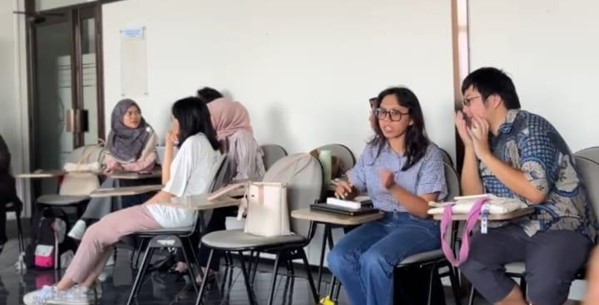
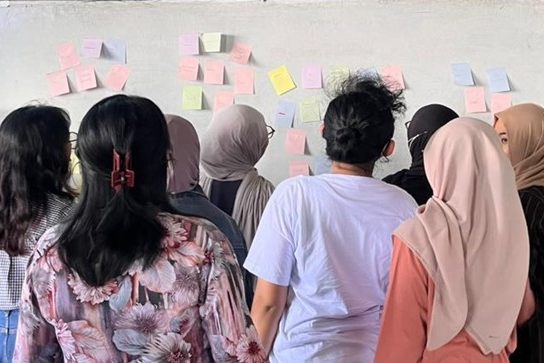
Yogyakarta, 24th November 2025 — Media and Cultural Program, Graduate School, Universitas Gadjah Mada, held another academic forum focusing on media, gender, and sexuality. The first session, titled “Intersectionality of Gender Identity.” It featured Dr. Arifah Rahmawati, M.A. as the main speaker, presenting key perspectives on identity, gender, and their intersections within contemporary cultural, social, and political contexts.
Dr. Arifah elaborated that identity consists of multiple social categories attached to individuals, shaping how they are perceived within society. Gender, as one of key dimensions of identity but a social construct continually shaped by cultural practices, policies, and evolving social norms, is not a fixed or natural attribute. Accordingly, gender roles and expressions may differ across spaces, time periods, and societal structures.
The further discussion emphasized that gendered experiences cannot be understood in isolation. The concept of intersectionality explains how gender interacts with other identity markers such as socioeconomic class, race, ethnicity, age, religion, disability, and more. These intersections create unique lived experiences, making it impossible to generalize the realities of women, men, or non-binary individuals as homogeneous groups.
Dr. Arifah also highlighted how gender inequality is often reproduced through stereotypes, gender blindness, and biased policies. When society or policymakers treat gender experiences as universal, decisions tend to become biased and risk marginalizing specific groups. Such biases impact not only participation and access but also the distribution of development benefits of different social groups.
She stressed the importance of gender-sensitive, gender-responsive, and gender-perspective approaches in designing policies, programs, and development initiatives. These approaches ensure that the diversity of gender experiences is acknowledged, accommodated, and addressed fairly so that all groups can enjoy equitable benefits.
The session concluded that understanding gender with an integrative and intersectional framework is essential for building a more inclusive society. Gender equality is not merely about the dynamics between men and women; it encompasses the broader influence of multiple identities that shape individuals’ experiences within social structures. Intersectional approaches are therefore crucial to eliminating injustice, expanding participation, and ensuring inclusive development for all members of society.
Through this academic forum, the Media and Cultural Studies Program reaffirmed its commitment to fostering critical, progressive, and socially aware academic spaces—especially around issues of identity, gender, and social justice.
Author: Khoirul Mujazanah