
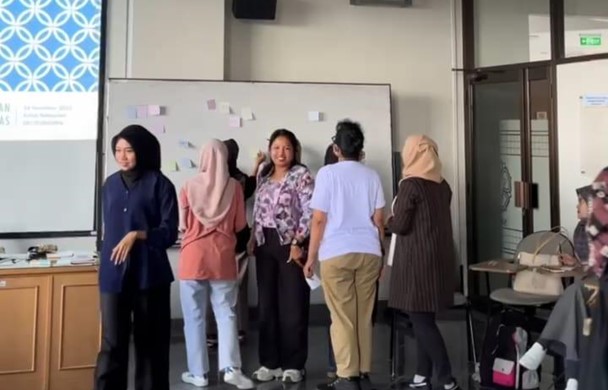


Yogyakarta, 27th November 2025 — The Media and Cultural Program at the Graduate School of Universitas Gadjah Mada continued its series of discussions on media, gender, and sexuality through its second session titled “Gender Dimensions in Violence and Peace.” The session featured Dr. Arifah Rahmawati, M.A., who emphasized the importance of understanding the relationship of gender, violence, and sustainable peacebuilding.
Dr. Arifah, in her opening remarks, explained that gender is not merely a biological distinction but a system of power that structures individuals’ access to authority, resources, and social opportunities. This system operates through three key dimensions: gender identity and roles, symbolic meanings such as cultural and visual representations, and institutional structures that often privilege dominant groups. Occupational stereotypes—such as the assumption that doctors are men while nurses are women—illustrate how social norms shape gendered expectations in society.
Dr. Arifah further elaborated that violence manifests in multiple forms. Beyond direct physical or verbal violence, there is also structural violence, embedded in policies, institutions, and social systems, as well as cultural violence, justified or perpetuated by societal norms and beliefs. Drawing on Johan Galtung’s framework, she noted that violence occurs when individuals or groups are prevented from understanding their full human potential due to systemic inequalities.
One of the most visible consequences of gender inequality is gender-based violence (GBV). This includes physical, emotional, and sexual abuse, child or forced marriage, and restrictions on access to education, healthcare, and economic resources. While GBV can affect individuals of all genders, women and girls remain disproportionately vulnerable. GBV not only causes physical and psychological harm to survivors but also affects family stability and broader social well-being.
Dr. Arifah, in discussing peacebuilding, highlighted the distinction of negative peace—the mere absence of war or conflict—and positive peace, which encompasses social justice, the fulfillment of human rights, and community well-being. True peace can only be achieved by eliminating all forms of violence, including those rooted in gender inequalities.
She emphasized the importance of cultivating a culture of peace grounded in non-violence, mutual respect, and the protection of human dignity. Crucially, peacebuilding efforts must involve groups marginalizing historically — particularly women — to ensure inclusive and participatory decision-making processes.
The Media and Cultural Program, through this session, reaffirmed its commitment in fostering critical academic spaces that address issues of gender equality, justice, and social transformation. The discussion also broadened students’ understanding of how social structures influence violence and how gender perspectives can strengthen peacebuilding agendas at both local and global levels.
Author: Khoirul Mujazanah