
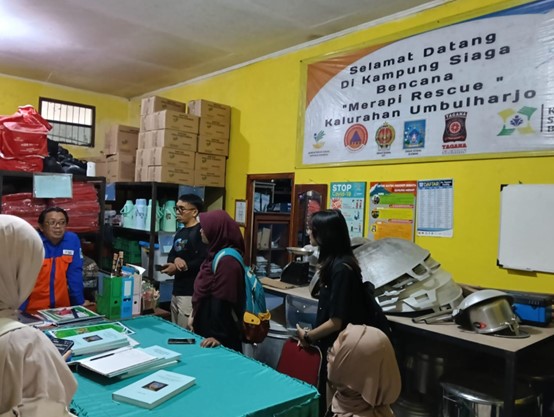
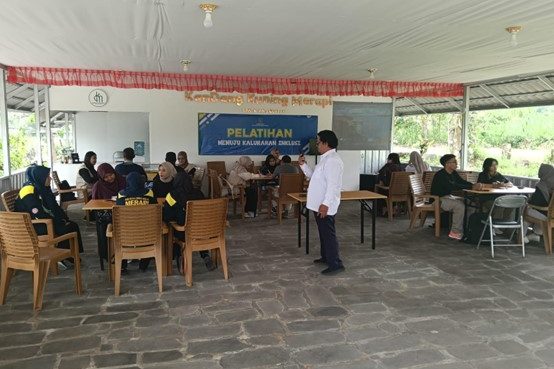
Yogyakarta, November 14th 2025-Disaster readiness is not just about stockpiles of logistics and evacuation barracks, but about building a system that serves all levels of society, without exception. This was the lesson absorbed by students of the Master of Disaster Management (MMB) program during a field study at the Umbulharjo Village Community Alert Group (KSB) in Cangkringan, Sleman. The visit, part of the Sociology of Disaster and Community Empowerment course, highlighted how KSB Umbulharjo—the second KSB formed in the Special Region of Yogyakarta (DIY)—does not only focus on logistics management but also has a grand vision to create an inclusive Umbulharjo Village. The humanist approach of KSB Umbulharjo is evident in their commitment to preparing facilities and infrastructure that are friendly to all vulnerable groups. “We are currently building an inclusive barracks,” revealed one of the KSB administrators. This barracks is seriously designed. Facilities such as ramps are available. Bathrooms are also designed to be near the barracks, using sliding doors, seated toilets, and wide doors to be fully accessible for persons with disabilities.
This vision of inclusivity does not stop there. KSB Umbulharjo also designs special arrangements for the nutritional fulfillment of infants, toddlers, and young children during evacuations. The KSB has even accommodated vulnerable groups such as the transgender community (beneser) and people with mental health disorders (ODGJ) in their barracks, before they were transferred to the Social Agency for further management at the Rusunawa (low-cost public housing). Their long-term plan is also set, with a target to establish an Inclusive Health Center (Puskesmas) by 2026. The main advantage of KSB Umbulharjo is its ownership of an independently managed logistics granary, unlike Destana (Disaster-Resilient Village) which generally does not have one. The granary, which has been organized since 2015, contains vital logistics such as rice, instant noodles, bread, and soy sauce, which have been digitized. “The granary has been digitized, so we can see the stock,” explained the administrator. This granary management demonstrates extraordinary professionalism, from monitoring Mount Merapi via live CCTV from BPTKG (Geological Disaster Technology Research and Development Center), calculating logistics based on the number of residents in the Disaster-Prone Zones (KRB) at 5 km and 7 km distances, with smart expiration management. If logistics are nearing their expiration date, the goods are not discarded but are instead distributed to underprivileged communities or used for social activities. They also face classic challenges like rice being prone to weevils and instant noodles being vulnerable to rats. However, solutions are prepared: rice with weevils will be re-milled, and the instant noodles are stored in large, rat-proof metal containers.
Behind this well-running system are resilient volunteers who dedicate their time and energy. These volunteers, who are part of KSB (under the Social Agency) and Destana (under the BPBD – Regional Disaster Management Agency), are often the same people to simplify coordination. Their dedication is purely for humanity. “There is no wages, only transportation and consumption allowances on duty,” said the administrator. Despite being unpaid, the KSB has an operational budget for volunteers and an emergency budget sourced from the village. To ensure preparedness, KSB Umbulharjo regularly conducts training, socialization, and simulations during the pre-disaster phase. The visit from the Master of Disaster Management students shows that KSB Umbulharjo is not just an alert group, but a model of community empowerment that prioritizes inclusivity, professionalism, and the sincerity of its volunteers.
Author: Berlian Belasuni