
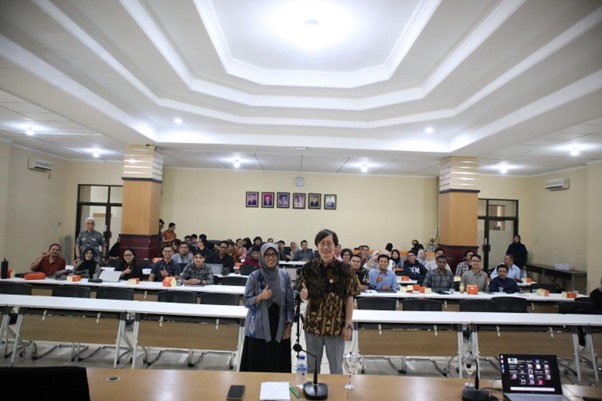
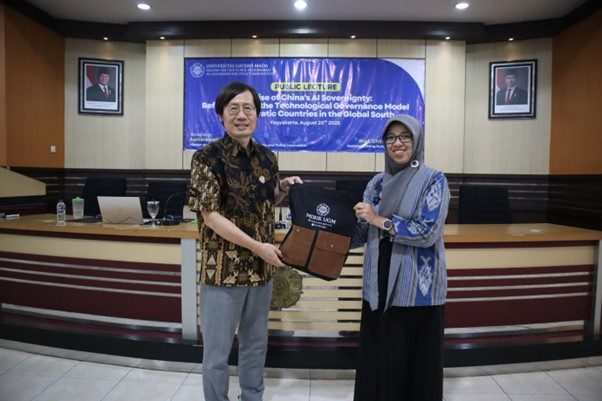
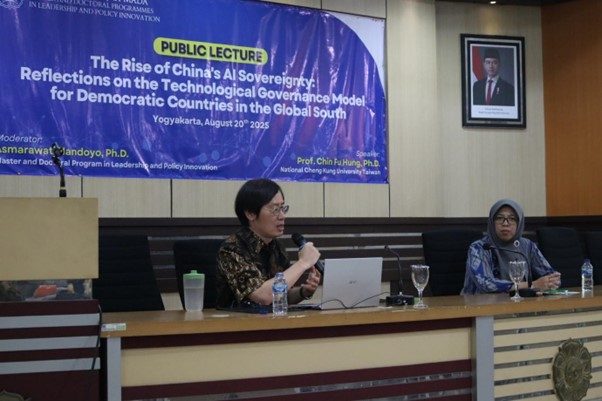
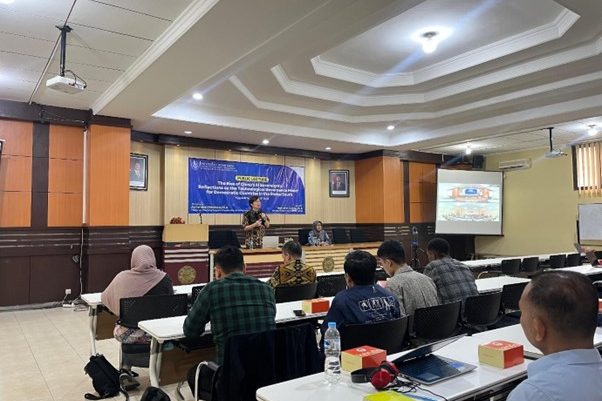
Yogyakarta, August 20th 2025 – The Leadership and Policy Innovation Study Program, Graduate School, Universitas Gadjah Mada, held a public lecture featuring an international guest speaker, Dr. Chin-fu Hung, Ph.D., Professor of Political Science at National Cheng Kung University, Taiwan. The lecture raised the theme “The Rise of China’s AI Sovereignty: Reflections on the Technological Governance Model for Democratic Countries in the Global South.”
Dr. Chin-fu Hung emphasized in his presentation that the development of artificial intelligence (AI) today is not only about innovation but closely related to sovereignty, national security, and political governance. China was mentioned as one of the most prominent countries with a comprehensive strategy that includes building technological infrastructure, implementing smart cities, developing a social credit system, and expanding global influence with the Digital Silk Road project. The concept of “AI Sovereignty,” according to Dr. Hung, refers to a country’s ability to independently regulate and control algorithms, data, hardware, and technological governance. While this model can effectively accelerate digital development, it also carries significant risks for democratic nations as it may undermine principles of transparency, accountability, and civil liberties.
Dr. Hung stressed that AI is not merely a technological issue but also one of values and governance principles. Therefore, democratic countries need to strengthen local capacity and avoid dependence on closed systems that could weaken digital autonomy. This dilemma is also encountered by many countries in the Global South, including Indonesia. The Chinese AI model appears attractive because it is fast, cost-effective, and proven, but if adopted without adjustment, it could potentially erode democratic values.
The discussion during the lecture was lively. Participants, consisting of students, lecturers, and researchers, raised many questions regarding Indonesia’s ongoing National Artificial Intelligence Strategy (Stranas KA) 2020–2045. Questions revolved around the government ability to balance rapid digitalization with commitments to data protection, public participation, and human rights. In response, Dr. Hung shared Taiwan’s experience through the g0v (gov zero) movement, which successfully integrated digital technology with transparency and public participation. He suggested that this model could serve as an inspiration for Indonesia in developing an inclusive and democratic AI governance framework.
The enthusiasm of the participants was evident from the number of questions and responses during the Q&A session. Students expressed great interest in issues of technological geopolitics and their implications for public policy in Indonesia. This public lecture became a valuable learning space that bridged global perspectives with local needs, enabling students to critically assess both the challenges and opportunities presented by AI in national development.
This activity reflects the commitment of the Leadership and Policy Innovation Study Program to enrich academic discourse with global perspectives. The presence of international experts hopefully will broaden students’ horizons therefore they will understand technology not only from a technical standpoint but also from the perspective of policy and democratic values. The program will continue to organize similar events to prepare students for the challenges of the digital era and to strengthen their contributions in shaping innovative, inclusive, and globally competitive policies.
Author: Khoirul Mujazanah