
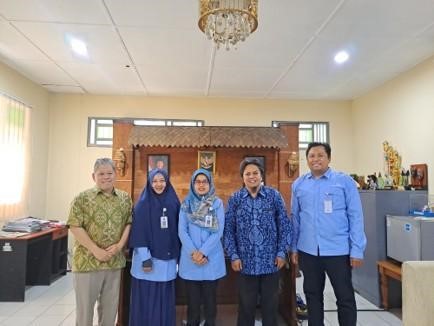

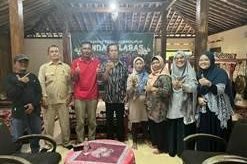
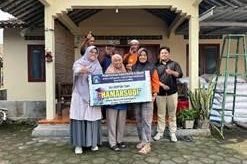
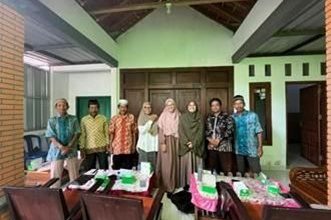

The Research Grant Team of the Islamic Economics Program, Graduate School of Universitas Gadjah Mada, conducted a study examining opportunities to increase rice productivity to strengthen food security in Sleman Regency, Special Region of Yogyakarta. The research was led by Prof. Dr. Catur Sugiyanto, M.A., Ph.D., together with team members Dr. Duddy Roesmara Donna, S.E., M.Sc., Nurfitri Harkunti Kemala Hayati, S.E., M.A., and Amelia Fitri Harahap, S.E.
This research was motivated by the phenomenon of rice productivity stagnance in Sleman in the past few years, a condition that contrasts with the region’s strong ecological potential. Sleman benefits from fertile volcanic soil from Mount Merapi and relatively well-developed agricultural infrastructure. However, climate change pressures, shifting seasonal patterns, and socio-economic dynamics have caused the performance of the food sector to operate below its optimal capacity.
The study aims to identify strategies to increase rice productivity and to examine the role of farmer groups and Field Agricultural Extension Officers (PPL) in improving rice productivity in Sleman Regency. Data were collected through questionnaires distributed to farmers and PPLs, as well as in-depth interviews with farmer group leaders and PPLs in Sleman Regency.
The research team collaborated with the Agriculture, Food, and Fisheries Office of Sleman Regency in data collection and coordination with farmer groups across 17 kapanewon (sub-districts) in Sleman Regency. This collaboration proceeded smoothly; the relevant government office provided full support, and the respondents received the study positively, enabling comprehensive and representative data collection.
The research findings revealed rice productivity in Sleman Regency can still be significantly improved without increasing the use of fertilizers, pesticides, or labor. The key lies in more efficient input use and better farm management. Based on surveys of farmers and extension officers, as well as technical analysis using the Data Envelopment Analysis (DEA) method, it was found that, on average, farmers have only reached 78% of their best potential in managing land and production inputs. In other words, there remains considerable potential to increase yields without incurring substantial additional production costs.
Several sources of inefficiency were identified in four main aspects: poorly scheduled labor use, fertilizer application exceeding optimal doses, pesticide use without proper consideration of pest infestation thresholds, and unplanned capital expenditures at the early planting stage. Regional differences also affect efficiency. Areas such as Moyudan—with better irrigation systems and active farmer groups—demonstrated higher efficiency compared to areas like Godean, which still face water limitations and insufficient technical assistance.
DEA findings provide operational policy directions able to be immediately implemented at both farmer and local government levels. Four priority strategies can be developed: 1)Land-need-based labor optimization: Strengthening work-time planning and appropriate mechanization to reduce wasted labor hours and costs; 2) Balanced fertilization based on location-specific recommendations: Implementing site-specific nutrient management to reduce fertilizer costs with long-term soil health maintenance; 3) Observation- and ecosystem-based pest control: Applying Integrated Pest Management (IPM) to reduce excessive pesticide use while maintaining crop resilience against pests and diseases; 4) Discipline in working capital use and cost–benefit education: Supporting farmers in farm record-keeping and cost evaluation to better direct pre-planting expenditures.
Prof. Dr. Catur Sugiyanto, as the team leader, emphasized that increasing productivity does not always mean increasing inputs. “What is needed is a larger appropriate way of working and stronger institutional support. That approach is far more sustainable for farmers and the environment,” he stated.
These strategies must be supported by upstream sector reforms, including strengthening the role of agricultural extension services as facilitators of climate adaptation technologies, reinforcing farmer group institutions as centers for sharing best practices, improving irrigation development priorities in low-efficiency areas, and implementing incentive policies that encourage youth involvement in agriculture.
Overall, the research findings emphasize that the future of food security in Sleman does not depend on input intensification, but rather on efficiency, farmers’ managerial capacity, and the resilience of local institutions in facing increasing climate variability and economic pressures.
This activity aligns with the implementation of the Sustainable Development Goals (SDGs): Zero Hunger through increased productivity and food security; SDG 8 – Decent Work and Economic Growth through cost efficiency, income improvement, and better labor structures; SDG 12 – Responsible Consumption and Production by reducing agricultural input waste and excessive chemical use; and SDG 13 – Climate Action through efficiency-based climate adaptation and pest risk mitigation.
Author: Prof. Catur
Editor: Ana A. Arni