
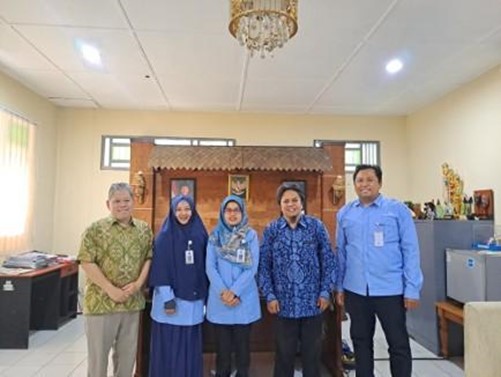
Yogyakarta, 12th January 2026 — The Research Grant Team of the Islamic Economics Research Interest at the Graduate School of Universitas Gadjah Mada (SPs UGM) was conducting a study examining opportunities to increase rice productivity in support of food security in Sleman Regency, Special Region of Yogyakarta. The research is led by Prof. Dr. Catur Sugiyanto, M.A., Ph.D., together with team members Dr. Duddy Roesmara Donna, S.E., M.Sc., Nurfitri Harkunti Kemala Hayati, S.E., M.A., and Amelia Fitri Harahap, S.E.
The study is motivated by the stagnation of rice productivity in Sleman over the past several years, despite the region’s considerable ecological potential, particularly the fertile volcanic soils of Mount Merapi and relatively well-developed agricultural infrastructure. Climate change pressures, shifts in seasonal patterns, and socio-economic dynamics are considered the key factors preventing the food sector from operating at its optimal capacity.
The primary objective of the research is identifying strategies to increase rice productivity and to examine the roles of farmer groups and Agricultural Extension Officers (Penyuluh Pertanian Lapangan/ PPL) in supporting farm performance. Data were collected through questionnaire surveys administered to farmers and extension officers, as well as in-depth interviews with heads of farmer groups and PPLs across 17 kapanewon (sub-districts) in Sleman Regency. Data collection was conducted in collaboration with the Sleman Regency Office of Agriculture, Food, and Fisheries, which provided full support, enabling the acquisition of comprehensive and representative data.
The findings indicate the rice productivity in Sleman can be significantly improved without increasing production inputs such as fertilizers, pesticides, or labor. Based on technical analysis using the Data Envelopment Analysis (DEA) method, the average farmer has achieved only around 78 percent of the optimal efficiency level. This suggests considerable room for improvement through more efficient input use and better farm management practices.
Inefficiencies were identified in several key areas, including ineffective labor scheduling, excessive use of fertilizers and pesticides, and unplanned management of initial planting capital. In addition, regional disparities—particularly in irrigation availability and the level of farmer group activity—also influence efficiency levels across sub-districts.
The chief of the research team, Prof. Dr. Catur Sugiyanto, emphasized the increasing productivity does not necessarily mean adding more inputs. “What is needed is more precise and efficient working methods, supported by strong institutions. This approach is far more sustainable for both farmers and the environment,” he stated.
Overall, the study underscores that the future of food security in Sleman Regency depends heavily on improved efficiency, strengthened managerial capacity among farmers, and resilient local institutions capable of addressing the challenges of climate change and economic pressures.
SDGs Keywords: SDG 2: Zero Hunger; SDG 8: Decent Work and Economic Growth; SDG 12: Responsible Consumption and Production; SDG 13: Climate Action
Source: Catur Sugiyanto
Editor: Asti Rahmaningrum
Photo: Catur Sugiyanto