
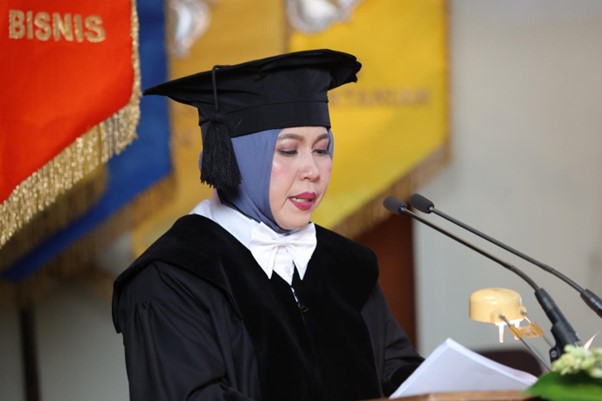
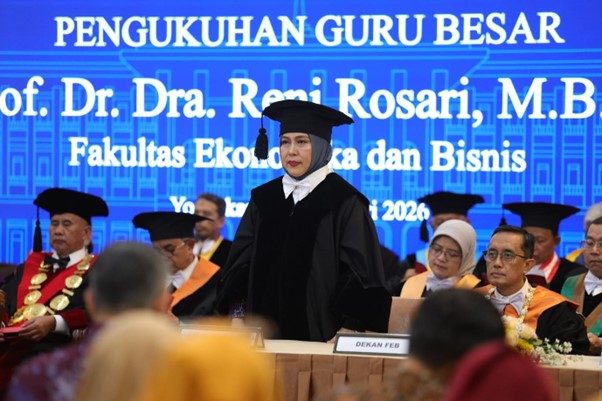
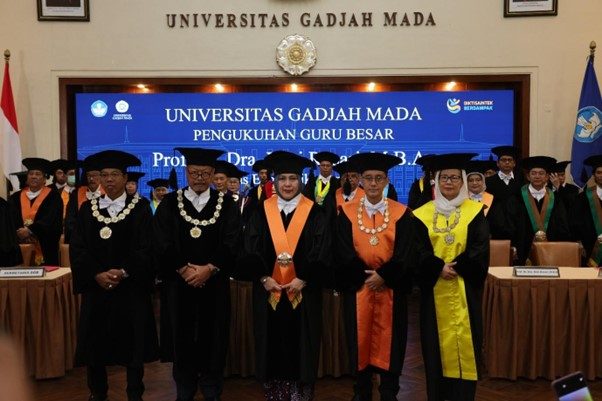
Yogyakarta, 19th February 2026 — The inauguration of Prof. Dr. Reni Rosari, M.B.A. as Professor in the field of Organizational Behavior at the Faculty of Economics and Business, UGM, marked a reflective and inspiring moment for the development of academic leadership within the Graduate School of UGM.
In the speech titled “Rumongso Melu Handarbeni: A Sense of Belonging as the Foundation of Happiness- and Collaboration-Based Organizations,” Prof. Reni emphasized that the sustainability of modern organizations is supported by systems and structures and by the depth of human belonging within them.
Her perspective as Chief of a Program at the Graduate School of UGM, this idea is not merely conceptual, but serves as a practical foundation in managing the program. According to her, the dynamics of higher education organizations today operate with increasing complexity and performance pressures. Amid administrative demands, accreditation processes, and performance indicators, there is a risk of losing meaning and human connectedness within the organization.
Prof. Reni, as Chief of Study Program, views a study program as a living system that will only grow when lecturers, educational staff, and students feel emotionally and morally connected. She draws on the Javanese philosophy rumongso melu handarbeni as a leadership value relevant to academic governance: a sense of belonging is not about control, but about collectively safeguarding and nurturing.
“A sense of belonging in the academic context means building collective awareness that the quality of the study program is a shared responsibility. It is not solely the leaders’ responsibility, but that of the entire academic community,” she asserted.
In her leadership practice, this value is manifested through a collaborative approach—encouraging active participation of lecturers in decision-making, opening spaces for dialogue, and cultivating a culture of mutual trust. Working relationships are no longer transactional, but transformational, oriented toward shared growth.
Prof. Reni also stressed that happiness and academic performance are not mutually exclusive. Productivity emerges from an environment that values individual contributions, provides space for participation, and fosters attachment to a shared vision. A study program with a soul, in her view, is one that nurtures rather than merely demands; one that empowers rather than pressures.
Concluding her reflection, she quoted the Javanese expression “Urip iku urup”—life is to give light. In the context of academic leadership, she believes that a study program will endure and thrive when it is able to ignite meaning for every individual within it.
Author: Arfikah Istari