
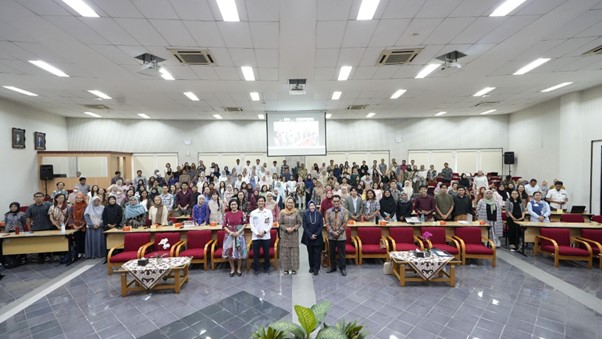
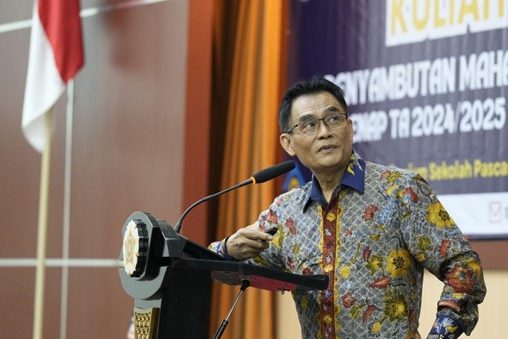
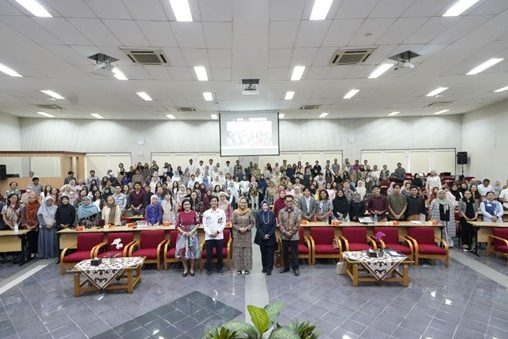
The Graduate School (SPs) of Universitas Gadjah Mada (UGM) held its Opening Lecture to welcome new students for the Even Semester of the 2024/2025 Academic Year and the Odd Semester of 2025/2026. The event carried the theme: “Transformation Towards an Indonesia with Excellent Human Resources”. The keynote speaker was Prof. Dr. Ir. Djagal Wiseso Marseno, M.Agr, who emphasized the importance of strengthening human resource (HR) quality as a key to establish Golden Indonesia 2045.
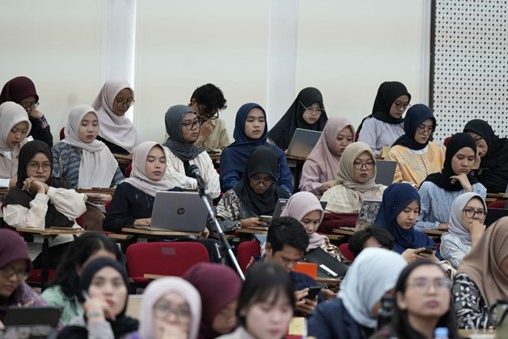
Attended by approximately 500 students, the event took place over two days—Monday and Tuesday, September 15th and 16th 2025—at the 5th Floor Auditorium of the SPs UGM Building, and in the front hall of the Auditorium Rooms 405 and 407 on the 4th floor, and Room 307 on the 3rd floor.
Prof. Djagal highlighted, in his presentation, that Indonesia still encounters various challenges. “Indonesia’s Human Development Index (HDI) remains low and uneven, the education level of the labor force is low, national competitiveness is weak, talent development is suboptimal, and the intelligence quality of human resources is still below average.”
Furthermore, according to Prof. Djagal, there are several unsettling facts—what he referred to as “horror facts”—related to Indonesia’s HR. These include weaknesses in intelligence, program content, institutions, delivery methods, infrastructure, budgeting, regulations, and collaboration. If these aspects are not urgently strengthened, it will be difficult for Indonesia to make the leap toward becoming a competitive nation.
Prof. Djagal also stressed the need for human resources that are both educated and enlightened. “Educated but unenlightened human resources are dangerous. The country could collapse; it could be sold off,” he warned.
As a solution, he proposed a human resource transformation strategy through strengthening seven key aspects: intelligence, program content, institutions, delivery methods, infrastructure, budget, regulations, and networking. He asserted that the government, together with relevant stakeholders, must focus on strengthening institutions, regulations, funding, and infrastructure so that HR development programs can be implemented systematically.
Prof. Djagal also outlined a vision of the ideal future condition of Indonesia’s human resources: high and evenly distributed HDI, improved education levels of the workforce, strong national competitiveness, robust talent development, and high intellectual quality of HR. “If these goals are achieved, it will lead to strong national resilience and the establishment of the Golden Indonesia 2045 vision,” he asserted.
This opening lecture was a welcoming event for new SPs UGM students and also a moment for collective reflection on the importance of educational transformation and strengthening human resources. With the presence of academics, students, and stakeholders, SPs UGM reaffirmed its commitment to producing outstanding graduates ready to face global challenges and contribute to national development.
Prof. Djagal, who previously served as UGM’s Vice Rector for Education, Teaching, and Student Affairs (2017–2022), also served as the Dean of the Faculty of Agricultural Technology (2008–2012). From 2014 to 2017, he was Deputy for Strategic Studies at the National Resilience Institute (Lemhannas) of the Republic of Indonesia.
This event is aligned with the implementation of the Sustainable Development Goals (SDGs) Goal 1: No Poverty, Goal 2: Zero Hunger, Goal 3: Good Health and Well-being, Goal 4: Quality Education, Goal 5: Gender Equality, Goal 8: Decent Work and Economic Growth, Goal 16: Peace, Justice and Strong Institutions, Goal 17: Partnerships for the Goals
Writer: Arni W
Editor: Ana A