
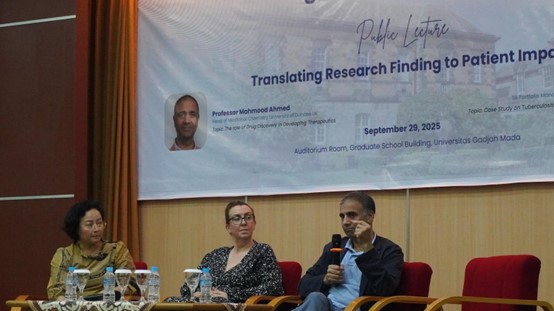
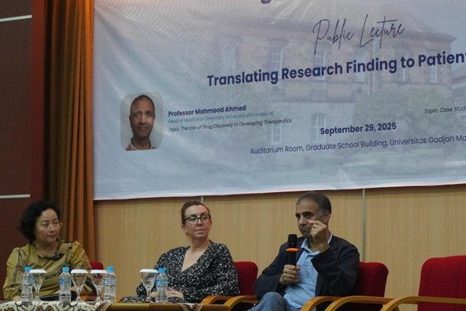
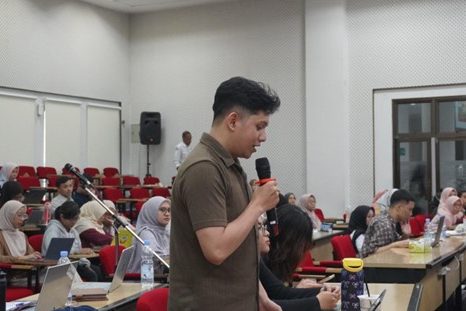
Yogyakarta, September 29th 2025 — Universitas Gadjah Mada (UGM) once again affirmed its commitment to enriching students’ academic knowledge through international collaboration. UGM’s Graduate School, specifically the Biotechnology Program, successfully held a prestigious public lecture highlighting the crucial journey of drug discovery, from the laboratory bench to tangible patient benefit. The event, titled “Translating Research Finding to Patient Impact,” was an integral part of the Transnational Education (TNE) Grant implementation, fostering close cooperation between UGM and a leading global institution. The lecture took place on Monday, September 29th 2025, in the Auditorium on the 5th Floor of the UGM Graduate School Building, drawing the keen attention of dozens of postgraduate students enthusiastic about applied biotechnology and therapeutic development.
This collaboration is the result of a strategic synergy of the UGM Graduate School and the School of Life Sciences, University of Dundee, UK, an institution renowned for excellence in life science research and drug discovery. The event, more than just an academic enrichment activity, served as a platform to strengthen international academic collaboration and broaden students’ perspectives on the global approaches used in modern drug discovery.
The participants, predominantly active Master’s (S2) and Doctoral (S3) students from the Biotechnology Program, along with UGM students from related disciplines. It was a rare opportunity to absorb knowledge directly from experts on the frontline of research. The public lecture featured two prominent expert speakers from the University of Dundee who provided deep insights from distinct yet complementary perspectives:
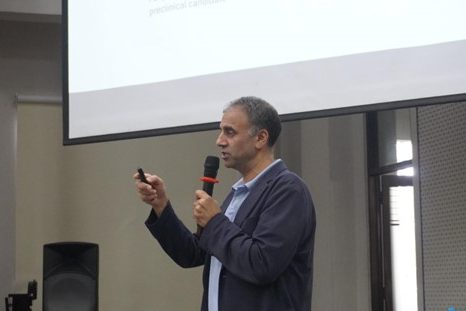
- Professor Mahmood Ahmed, Chief of Medicinal Chemistry at the University of Dundee, delivered a key presentation on “The role of drug discovery in therapeutic development.” Prof. Ahmed emphasized how medicinal chemistry—the science combining organic chemistry, biochemistry, and pharmacology—plays a central role in designing, synthesizing, and developing new drug molecules. He explained the complex, iterative process of optimizing lead compounds to achieve adequate efficacy, safety, and pharmacokinetic properties for drug development.
- Laura Cleghorn, Tuberculosis (TB) Portfolio Manager at the University of Dundee, presented a highly relevant and in-depth view through the “Case Study of a Tuberculosis (TB) Drug Discovery Project.” Dr. Cleghorn shared real-world experiences from their project, illustrating the challenges and strategies employed in developing new drugs to combat this infectious disease, which remains a global health problem. This case study provided a concrete picture of how laboratory research findings are translated step-by-step into therapeutic solutions with direct patient impact.
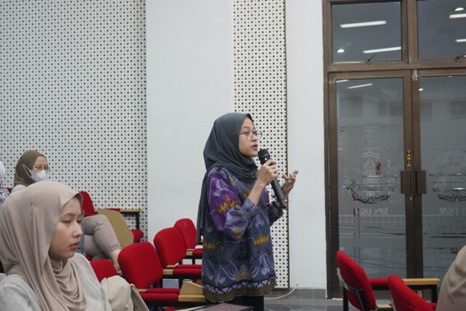
The insightful session was expertly moderated by Dewi Kartikawati Paramita, S.Si., M.Si., Ph.D., an UGM academic. The discussion atmosphere became highly interactive during the Q&A session, where students actively delved deeper into the translational process, regulatory challenges, and research opportunities. The main objectives of this public lecture went beyond mere knowledge transfer. Specifically, the event was designed to:
- Provide Comprehensive Knowledge: Equip students with a complete understanding of the translational process from fundamental research findings to tangible patient impact.
- Expand Understanding: Stress the critical role of medicinal chemistry in drug discovery and its practical relevance to patient health.
- Encourage Impactful Research: Motivate Master and Doctoral students to design and execute research proposals that are not only academically excellent but also possess clear translational potential—the ability to be developed into clinically beneficial products or services.
With such activities, UGM can continue to produce researchers and professionals mastering the theories of biotechnology and medicinal chemistry and also possess a global vision and commitment to translate research excellence into real health innovations for the wider community.
Author: Berlian Belasuni