
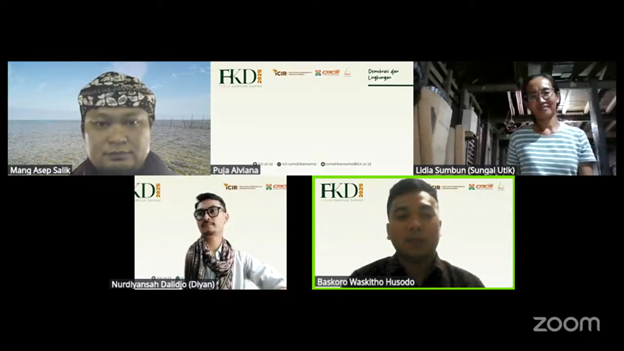
The Center for Religious and Cross-cultural Studies (CRCS), Graduate School of Universitas Gadjah Mada (UGM), in collaboration with the Intersectoral Collaboration for Indigenous Religions (ICIR), once again held the 2025 Forum Kamisan Daring (FKD) on Thursday (03/07) virtually via Zoom Meeting and YouTube.
This FKD session carried the theme “Ancestral Heritage and Local Food Security Amid the Threat of Gastrokolonialism.” The theme invited participants to reflect on a new form of colonialism that no longer arrives through armed violence but instead through taste, instant food products, and a global food system that gradually displaces indigenous sovereignty and local wisdom.
The speaker, Lidia Sumbun, a representative of the Sungai Utik Indigenous Community, shared her community’s practices in maintaining food security based on ancestral heritage and environmental sustainability. According to Lidia, her community has long prioritized the cultivation and consumption of local plants passed down through generations.
“We always prioritize local plants inherited from our ancestors. Plants from outside usually don’t last long. Local plants are beneficial, planted without chemical fertilizers—only with burnt soil and natural fertility,” Lidia emphasized in her presentation.
Another speaker, Nurdiyansah Dalidjo, author of the book “Rumah di Tanah Rempah” (House in the Land of Spices), discussed how the history of colonialism is closely linked to food narratives and local food systems. He highlighted the importance of remembering and preserving cultural food practices as part of identity and resistance against foreign domination.
“Colonialism has disrupted good practices within indigenous communities, such as values related to food, sacredness, religiosity, and sustainable local agricultural systems,” he stated.
Mang Asep Salik, a discussant and observer of religion and local food issues, emphasized that the loss of local food identity impacts not only cultural aspects but also the spiritual values embedded in community traditions.
“Local food is often overlooked because it is seen as outdated. Yet behind every local ingredient, there are values, prayers, and a way of life that maintains the balance between humans and nature,” he explained.
The discussion proceeded interactively, with participants from various backgrounds offering responses and questions. FKD 2025 once again served as a crucial space to raise awareness on the importance of preserving local food, promoting environmental sustainability, and protecting the cultural identity of indigenous communities in the midst of globalization and food modernization.
Author: Asti Rahmaningrum