
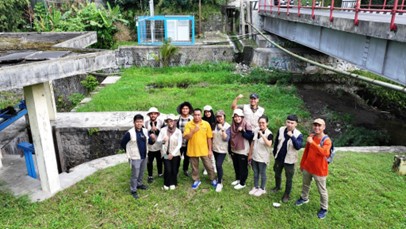

Yogyakarta, June 12th 2025 – Students of the Disaster Management Master Program (MMB SPs UGM) at the Graduate School of Universitas Gadjah Mada conducted a field visit to several strategic locations in Sleman Regency to directly observe the monitoring and early warning systems implemented to address various disaster threats. This visit was part of the “Disaster Source Monitoring and Early Warning” course taught by Dr. Nugroho Christanto, S.Si., M.Si.
The observation activity began in the upper area of the Gadjah Wong River, especially in Sardonoharjo, Ngaglik, Sleman. In this location, a flood monitoring system using sensor-based technology and the Watermoon digital platform. All data is transmitted via wireless network and can be accessed online to support early decision-making before floods affect the more densely populated downstream areas.
The visit continued to the Kali Boyong area, at the border between Candibinangun and Purwobinangun, Pakem. This river is one of the main channels for cold lahar flow from the southern slope of Mount Merapi. The early warning system implemented is using similar components to those in the previous location but focused on detecting potential cold lahar floods carrying large volumes of volcanic material.
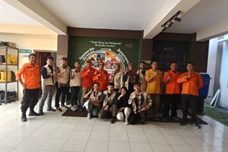
The next stop was the Operations Control Center (Pusdalops) of the Sleman Regional Disaster Management Agency (BPBD), located in Pakembinangun. Pusdalops functions as the command center for emergency response and disaster information management. All field data is consolidated here and disseminated through various communication channels such as handy talkies, SMS blasts, community radio broadcasts, sirens, social media, and digital applications.
The visit concluded at the Bronggang Sabo Dam located in Suruh Hamlet, Argomulyo Village, Cangkringan District. This sabo dam is part of the lahar sediment trap network built along the Gendol River, functioning to block volcanic material flow during cold lahar floods.
Many early warning systems still operate partially without integrated data or command, which could potentially hinder the speed and accuracy of information during disasters. Therefore, strategic steps are needed to merge these systems into a standardized disaster data framework and to promote interoperability between institutions.
Sleman can continue moving towards a more resilient and integrated disaster risk management system to face the dynamics of multi-hazard threats, with strengthened coordination, data integration, and adaptive technology .
Authors: Firli Yogiteten and Muhammad Taqi
Editor: Siti Muyasaroh