• About UGM
  • Students Portal
  • Library
  • IT Center
  • UGM Mail
  • Informasi Publik
  • English
    • Bahasa Indonesia
    • English
Universitas Gadjah Mada THE GRADUATE SCHOOL OF
UNIVERSITAS GADJAH MADA
  • Home
  • About Us
    • About Us
    • Excellence
    • Status
    • Management Structure
    • Campus Life
    • Facilities and Services
    • Contact Us
  • Academics
    • Announcement
    • Academic Documents
    • Academic Calendar
  • Admission
    • Study Programs
    • Scholarships
    • Admission Requirements
    • How to Apply
    • Registration
  • Activities
    • Events
    • News
    • Research
    • Community Service
    • Universitas Gadjah Mada
  • Publication
  • Home
  • News
  • Extension and Development Communication Master Program Collaborated with the Faculty of Cultural Sciences Held Guest Lecture Class: Harro Maat Explores the Role of Local Knowledge in Colonial Agriculture in Java

Extension and Development Communication Master Program Collaborated with the Faculty of Cultural Sciences Held Guest Lecture Class: Harro Maat Explores the Role of Local Knowledge in Colonial Agriculture in Java

  • News
  • 26 May 2025, 09.57
  • Oleh: pudji_w
  • 0

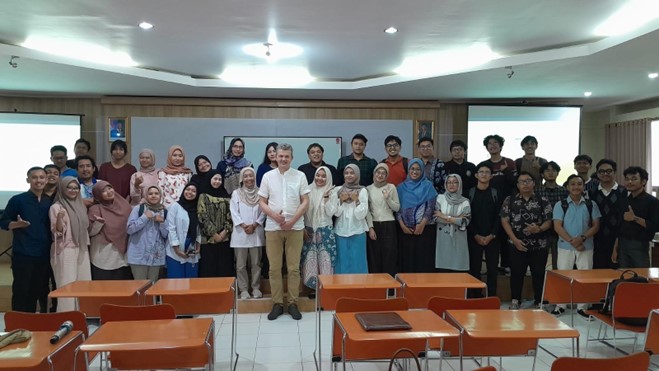
Yogyakarta, May 19th 2023 — The Extension and Development Communication Master Program collaborated with the Faculty of Cultural Sciences at Universitas Gadjah Mada (UGM), held a guest lecture at the Margono Building, Faculty of Cultural Sciences UGM. The event featured Harro Maat, Associate Professor at Wageningen University, Netherlands, as keynote speaker.

The lecture titled “The Colonial Reshaping of Agriculture on Java: The Role of Western Science and Farmers’ Knowledge”, Maat discussed how the colonial agricultural system in Java was not entirely controlled by Western science, but was also shaped by the active contributions of local knowledge from farmers and plantation workers.

According to Maat, the plantation system – considered the backbone of colonial agriculture, characterized by land control, limited cropping patterns, and its connection to global markets — relied heavily on interactions between colonial experts and local communities. “Many local practices and knowledge were adopted into the colonial agricultural system. This is evidence that farmers’ knowledge was not merely complementary, but a part of the scientific process itself,” he stated.

Harro Maat, as a researcher in the history and sociology of science and technology, places great emphasis on grassroots technology, sustainable agroecology, and food sovereignty, both in colonial and postcolonial contexts. His presence at the guest lecture is expected to broaden the perspective of master students in the Extension and Development Communication Master Program regarding the relationship between science, society, and agricultural development.

Author: Yeti Susilowati

Tags: SDG 10: Reduced Inequalities SDG 12: Responsible Consumption and Production SDG 17: Partnerships for the Goals SDG 4: Quality Education

Recent Posts

  • Consortium Meeting for JTTS Collaboration: Finalizing Research Findings for Sustainable Policy-Making in Sumatra
  • SPs UGM Strengthens Tridharma in Tourism: Doctoral Program in Tourism Studies Expands STO and Launches “Visitor Management” Book
  • Master’s and Doctoral Students of National Security Studies at UGM Graduate School Join Thesis and Dissertation Strengthening Bootcamp
  • Prof. Armaidy Armawi Presents Astropolitics and National Resilience at Senastindo VII AAU 2025
  • Population Studies PhD Program and BRIN Review Strategic Research Directions, Strengthen Collaboration in Research Partnerships
Universitas Gadjah Mada
THE GRADUATE SCHOOL OF
UNIVERSITAS GADJAH MADA
Jl. Teknika Utara, Pogung, Sinduadi, Mlati, Sleman, Yogyakarta, 55284
Telp. (0274) 544975, 564239
Email : sps@ugm.ac.id

© Universitas Gadjah Mada

KEBIJAKAN PRIVASI/PRIVACY POLICY

[EN] We use cookies to help our viewer get the best experience on our website. -- [ID] Kami menggunakan cookie untuk membantu pengunjung kami mendapatkan pengalaman terbaik di situs web kami.I Agree / Saya Setuju