
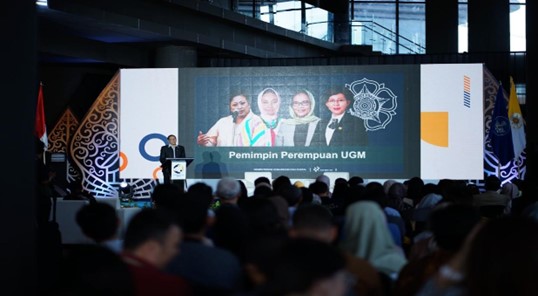
Yogyakarta, 11th November 2025 — Leadership Day 2025, organized by the Graduate School of Universitas Gadjah Mada (SPs UGM) through the Leadership and Policy Innovation (MDKIK) Master and Doctoral Program, together with the Alumni Association of the Master’s and Doctoral Program in Leadership and Policy Innovation (Kapimgama). The keynote speech, titled “Digital Leadership: Empowering Collaboration and Innovation for Indonesia’s Future,” was delivered by Raden Wijaya Kusumawardhana, Expert Staff for Social, Economic, and Cultural Affairs at the Ministry of Communication and Digital (Komdigi).
In his presentation, Raden Wijaya emphasized that digital leadership is not about mastering technology and using it to strengthen collaboration, expand inclusivity, and create innovations with real social impact. “Digital leadership is about building connections, not just connectivity; about empowerment, not control,” he said in his opening remarks.
He highlighted that Indonesia holds great potential to lead amid the global wave of digitalization, provided that its leadership development remains grounded in human-centered values. In this regard, he praised Universitas Gadjah Mada for nurturing many visionary leaders, including women leaders across various sectors. “UGM is a true example of how a university can produce leaders who are intellectually capable and socially conscious and committed to equality,” he noted.
Within the framework of national digital policy, Raden Wijaya outlined the strategy for building an inclusive and equitable digital ecosystem, focusing on four key priorities:
- Equitable digital infrastructure, including expanding access to 3T areas (frontier, outermost, and underdeveloped regions).
- Strengthening women’s digital talent with scholarship programs and the AI Talent Factory initiative to produce more digital leaders.
- Advancing digital innovation and entrepreneurship, through initiatives such as the Garuda Spark Innovation Hub, which supports sustainable growth of local startups.
- Building a safe and healthy digital space, by enhancing digital literacy, data security, and ethical technology use.
“We are not building technology for technology’s sake, but for humanity. Collaborative and empathetic values must be the soul of every digital policy,” he asserted.
Raden Wijaya also reminded that digital leadership is relevant for the government or the private sector, but also to individuals and communities. True digital leaders, he said, are those who are able to connect human potential with the power of data and innovation.
This session reaffirmed that digital leadership is not merely a technical skill, but a reflection of a new paradigm of leadership — one that is open, adaptive, empathetic, and collaboration-oriented.
Universitas Gadjah Mada, through Leadership Day 2025, particularly the Master’s and Doctoral Program in Leadership and Policy Innovation (MDKIK) of the Graduate School, once again reaffirmed its role as a catalyst for change — nurturing future leaders capable of navigating digital disruption with both heart and human-centered vision.
Writers: Naufal Sabda Auliya and Rosyida Indah Mawarni
Editor: Arfikah Istari