
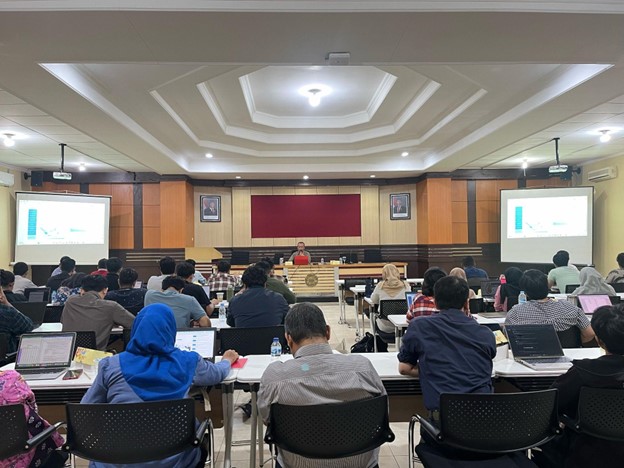
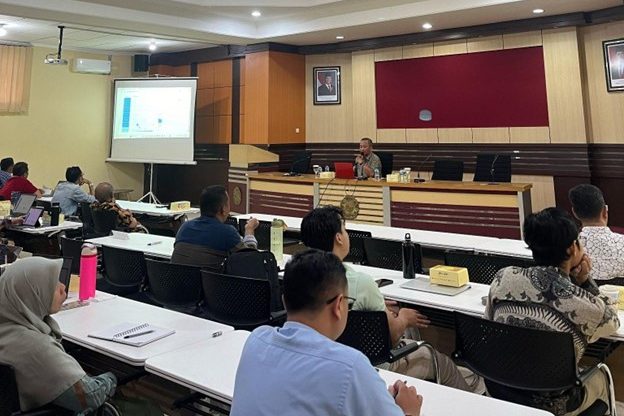
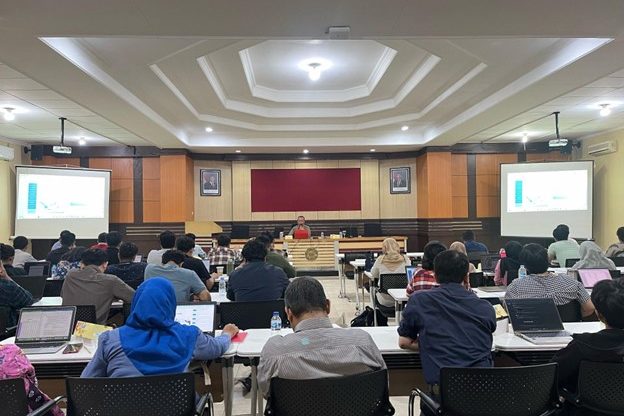
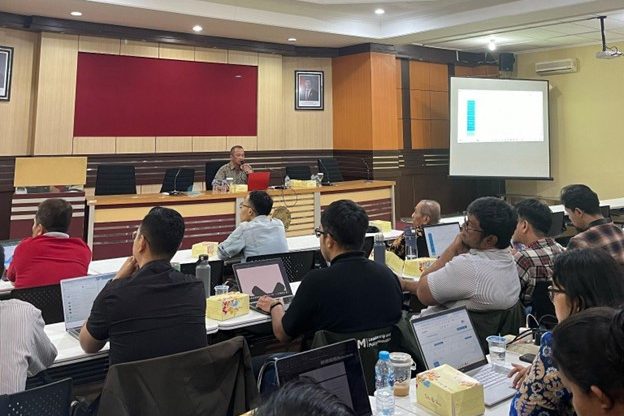
The Leadership and Policy Innovation Master and Doctoral Program (MDKIK), Graduate School of Gadjah Mada University (UGM), held a public lecture titled “Digital Dashboard: From Theory to Real-World Cases” on Thursday February 2nd. In this session, Wahyono Kuntohadi, S.Si., Stat., M.Sc.QM, a statistics expert and visual analytics architect, delved into the primary challenges in digital dashboard development, particularly in terms of data accuracy and validity.
Wahyono in his presentation, highlighted that digital dashboards have become essential tools for data-driven decision-making, the biggest challenge remains ensuring that the data used is truly accurate and valid. He explained that dashboards unsupported by credible data can lead to misleading analyses, ultimately affecting policy decisions.
One of the main challenges is the increasing complexity of data. With the advancement of Big Data and the Internet of Things (IoT), the volume and variety of data entering dashboards have grown significantly. This can pose problems in data filtering and validation. Wahyono pointed out that much of the data collected comes from various sources that may not adhere to the same standards in recording and reporting. Therefore, strong mechanisms are needed to clean and filter data before using it for analysis.
Moreover, the reliability of data is also a significant concern. Errors in data collection or recording can introduce bias in the visualizations displayed on dashboards. For instance, data that is not updated in real-time or discrepancies in measurement methods across different regions can lead to inconsistencies in analysis. Wahyono emphasized the importance of implementing strict data management standards and leveraging artificial intelligence (AI) algorithms to detect anomalies and inconsistencies in data.
Another challenge is the integration of data from various disparate systems. In the context of public policy, data is often scattered across multiple institutions in different formats. Without proper integration systems, dashboards risk presenting incomplete or even contradictory information. Wahyono stressed the need for high interoperability between platforms and clear data governance policies to ensure that dashboards function effectively as monitoring tools.
Concluding his lecture, Wahyono asserted that challenges in data accuracy and validity are not insurmountable. The commitment to improve data management quality, the adoption of appropriate technology, and synergy among stakeholders, digital dashboards can become reliable instruments for evidence-based decision-making.
The public lecture was well-received by students, lecturers, and researchers in attendance. It is hoped that this discussion raises awareness among academics and practitioners about the importance of quality data management in digital dashboard development for more adaptive and accurate public policy.
Writer : Vivie Silvania Intan Nirmala