
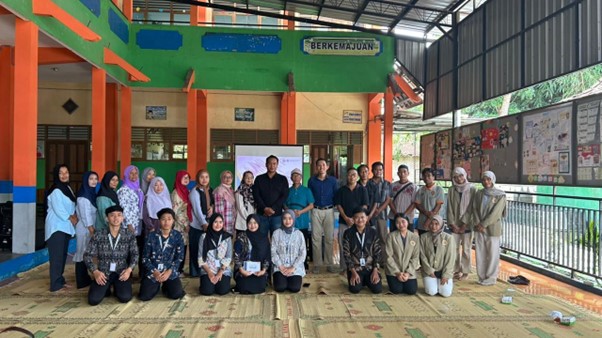


Yogyakarta, 17th November 2025-The Master’s Program in Disaster Management (MMB) at the Graduate School of Universitas Gadjah Mada (UGM) demonstrated its active role in community service based on scientific knowledge by dispatching four of its students—Tamara, Vira, Farah, and Afni—to assist in earthquake mitigation education activities. The event, held in Padukuhan Sumber, Balecatur, Gamping, Sleman, on Saturday, November 15, 2025, was the result of a strategic collaboration between MMB UGM, the Center for Disaster Studies (PSBA) UGM, and the UNY Student Community Service (KKN) Group KKNM 27127. The direct involvement of these postgraduate students served as a concrete manifestation of applying the disaster science learned in the classroom, and simultaneously supporting efforts to enhance community capacity, particularly among school principals, neighborhood chief (Ketua RT), and community unit chief (Ketua RW) who are key actors in establishing readiness in the region.
The Chief of Padukuhan Sumber, Mr. Fothurohman Rusdyanto, in his opening remarks, expressed deep appreciation for the initiative and the presence of the MMB UGM students who assisted the speaker from PSBA UGM, Mr. Muhamad Irfan Nurdiansyah. According to Mr. Rusdyanto, the presence of the Master’s students in Disaster Management brought a vital additional perspective, as they not only studied theory but were also able to bridge and help explain disaster situations more broadly and practically to the residents. This collaboration showcases the strong relationship between academics and residents in strengthening community resilience.
Muhamad Irfan Nurdiansyah explained, during the material session, the basic concept of how earthquakes occur and presented the potential vulnerability of the Sleman region, especially the Gamping area, which is situated near the active fault lines in the Kulonprogo Mountains. The MMB UGM students played an important role in enriching this session by sharing field case examples and disaster studies they had explored during their lectures. They also emphasized the importance of community capacity by presenting learning data from the post-earthquake survey of the Great Hanshin Awaji in Japan in 1995. This data strongly indicated that the largest number of survivors were rescued by themselves (35%) and family members/neighbors (nearly 60%), which unequivocally reinforced the message of capacity building must begin with individuals, families, and the immediate environment, rather than solely relying on formal rescue teams. This data-based explanation received significant attention from the participants, encouraging them to better understand the urgency of strengthening local capacity.
The role of the MMB UGM students continued intensively into the practical session and evacuation simulation. Tamara, Vira, Farah, and Afni actively assisted the participants, helping guide them in practicing the safe Drop, Cover, and Hold movement correctly, while simultaneously ensuring the evacuation flow proceeded smoothly toward the safe assembly point. This direct and detailed assistance ensured the exercise was orderly, and served as a platform for the students to apply their technical disaster knowledge in a real-world setting.
This activity, for the MMB UGM students, was a golden opportunity to integrate classroom theories with social realities in the field. They acknowledged this experience as invaluable because it allowed them to witness firsthand how the community responds to disaster information, leading them to establish the importance of adapting mitigation theories to local social, cultural, and capacity conditions. This active involvement is proof of MMB UGM’s commitment in producing prospective disaster practitioners who are academically excellent, possess social sensitivity and the ability to interact effectively with the community. MMB UGM students, through these collaborative activities, have made a tangible contribution to strengthening community resilience against the threat of earthquakes, aligning with UGM’s vision as a people-oriented university.
Author: Berlian Belasuni