
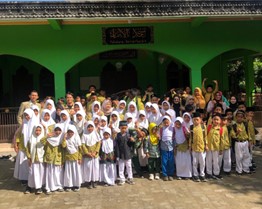


Yogyakarta, July 16th 2025 – Students from the Disaster Management Master Program at Universitas Gadjah Mada’s Graduate School (MMB SPs UGM) conducted a disaster awareness education activity at MI Ma’arif Ngliseng, located in Ngliseng Hamlet RT 07, Muntuk Village, Dlingo District, Bantul Regency. This school was severely affected by the Yogyakarta earthquake in 2006.
The school’s geographical location—near cliffs and landslide-prone areas—has driven its commitment to consistently instill disaster-related knowledge. This commitment was established with collaboration with UGM’s Disaster Management Master students, who carried out educational activities during the school’s Orientation Week (MPLS).
Representatives from the MMB students, including Muhamad Irfan Nurdiansyah, along with social action activists from HMP UGM, presented the disaster education in a creative and engaging way. Children were introduced to disasters such as earthquakes and volcanic eruptions and were taught how to protect themselves during such events.
The sessions included children’s films, thematic songs, and light discussions, making it fun and easy for students to understand. A total of 12 teachers accompanied students from grades 1 to 6 throughout the activity, reinforcing the integration of disaster education into regular school activities.
Ika Fitriyati, Principal of MI Ma’arif Ngliseng, welcomed the synergy with the UGM MMB students, stating that the program was highly relevant given the school’s disaster-prone location. She emphasized that disaster knowledge should be cultivated early on—not just as additional knowledge, but as part of students’ character development.
“We want our students to develop comprehensive intelligence—not only academically, but also with risk awareness and resilience,” she said.
The school, as part of LP Ma’arif NU, upholds values of independence, religiosity, and social awareness. Through this kind of collaboration, MI Ma’arif proves that even a small school in the hills can be a model for community-based resilience.
The teachers also gained new experiences and insights on integrating the principles of Safe School Units (SPAB) into their teaching processes. The activity created a learning environment that fosters courage, collective awareness, and decision-making skills in emergencies.
To conclude, Principal Ika Fitriyati expressed hope that this collaboration would be the start of a sustainable disaster education program. “We want our children to be not only academically smart but also smart in facing the risks around them,” she said. She also plans to establish a small disaster response group at the school consisting of students and teachers as a follow-up to this initiative.
Author: Muhamad Irfan Nurdiansyah
Editor: Siti Muyasaroh