• About UGM
  • Students Portal
  • Library
  • IT Center
  • UGM Mail
  • Informasi Publik
  • English
    • Bahasa Indonesia
    • English
Universitas Gadjah Mada THE GRADUATE SCHOOL OF
UNIVERSITAS GADJAH MADA
  • Home
  • About Us
    • About Us
    • Excellence
    • Status
    • Management Structure
    • Campus Life
    • Facilities and Services
    • Contact Us
  • Academics
    • Announcement
    • Academic Documents
    • Academic Calendar
  • Admission
    • Study Programs
    • Scholarships
    • Admission Requirements
    • How to Apply
    • Registration
  • Activities
    • Events
    • News
    • Research
    • Community Service
    • Universitas Gadjah Mada
  • Publication
  • Home
  • Community Service
  • Abundant First Harvest After SPs Well Assistance

Abundant First Harvest After SPs Well Assistance

  • Community Service, News
  • 19 August 2025, 11.28
  • Oleh: pudji_w
  • 0

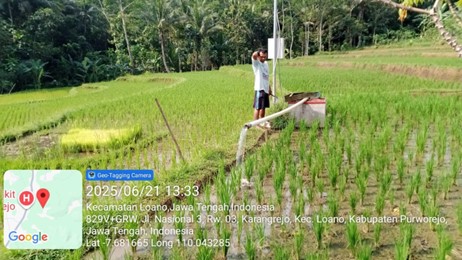
“Farmers in Karangrejo Village, Loano Subdistrict, Purworejo Regency, Central Java, on Monday (August 11th), experienced tremendous joy as they achieved a historical increase in rice harvest. Currently. It can reach up to 7 tons per hectare, whereas previously it was only 5 tons,” said Patnani, Head of Karangrejo Village.

This increase in harvest has been achieved since they received assistance in the form of bore wells for irrigation and clean water from the Graduate School of Universitas Gadjah Mada (UGM). These wells, developed through the Community Service Program (PkM), are capable of irrigating 5 hectares of rice fields. “Before the wells were installed, the planting pattern was one rice crop and one secondary crop (palawija) per year. Now, it’s possible to plant rice twice and palawija once,” Patnani added.

During the initial large-scale harvest following the bore well irrigation program, harvest reached an average of 7 tons of unhusked rice per hectare. In fact, for the Trisultan rice variety, it could reach up to 8.8 tons per hectare. Trisultan is a superior rice variety known for its high yield potential, short maturity period (95–100 days after planting), and resistance to various pests, diseases, and drought conditions.

The Chief of Karangrejo Village expressed gratitude to all parties who supported the provision of the bore wells, especially the Environmental Science Program and the Graduate School of Universitas Gadjah Mada. He also hopes that this collaboration will continue and expand into other areas. (Suronokarti)

Tags: SDG 1: No Poverty SDG 2: Zero Hunger SDG 3 – Good Health and Well-being SDG 6 – Clean Water and Sanitation

Recent Posts

  • Monitoring Activities On Kubu Raya’s Groundwater Potential: Environmental Management Master Program Graduate School UGM And West Kalimantan Provincial Government Ready To Solve The Clean Water Crisis
  • Promoting the Development of Statistical Human Resources, Doctoral Program in Population Studies Conducts Outreach to BPS Surakarta City
  • UGM Graduate School and the Ministry of Transmigration’s Collaboration: Held Final Report Exposé on the Economic Development Study of Transmigration Areas along the Trans-Sumatra Toll Road Corridor
  • PSPSR UGM Implementing “NUSA BUDAYA” Community Engagement Program in Pringgading, Bantul
  • MPRK UGM Introduced Human Security in UKSW Salatiga Study Visit
Universitas Gadjah Mada
THE GRADUATE SCHOOL OF
UNIVERSITAS GADJAH MADA
Jl. Teknika Utara, Pogung, Sinduadi, Mlati, Sleman, Yogyakarta, 55284
Telp. (0274) 544975, 564239
Email : sps@ugm.ac.id

© Universitas Gadjah Mada

KEBIJAKAN PRIVASI/PRIVACY POLICY

[EN] We use cookies to help our viewer get the best experience on our website. -- [ID] Kami menggunakan cookie untuk membantu pengunjung kami mendapatkan pengalaman terbaik di situs web kami.I Agree / Saya Setuju