
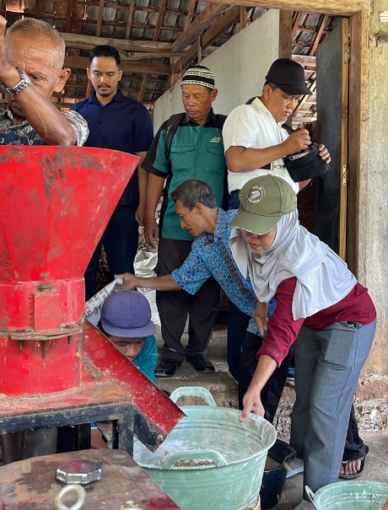
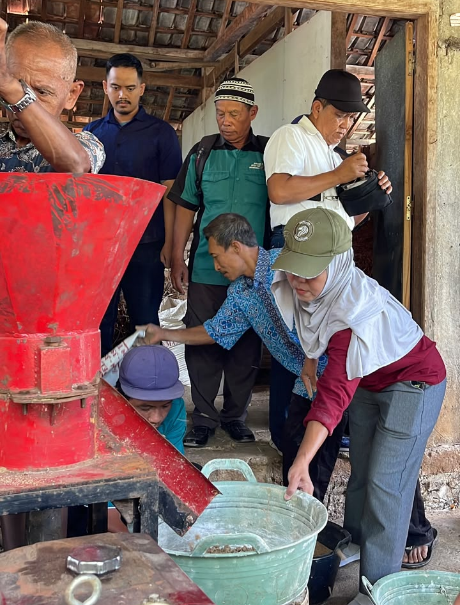
 National beef demand continuously increases every year. Data from 2024 indicated the deficit on the national beef supply reached 291.3 thousand tons, while total demand was approximately 724.2 thousand tons. One of the main factors limiting livestock productivity of farmers is the inadequate availability of forage, both in terms of quantity and quality. To address this challenge, a research team from the Development Communication and Extension Master Program (PKP), Graduate School of Universitas Gadjah Mada (UGM), coordinated by Prof. Dr. Ir. Siti Andarwati, S.Pt., MP., IPU., ASEAN Eng., collaborated with a research team from the National Research and Innovation Agency (BRIN), led by Prof. Dr. Ir. Gunawan, M.S. The initiative was also carried out in partnership with the Margo Mulyo Banaran Livestock Farmers Group in Playen District, Gunungkidul Regency.Together, they introduced an innovative solution established in complete feed technology formulated with precision using locally sourced ingredients.
A Local Solution for National Food Security
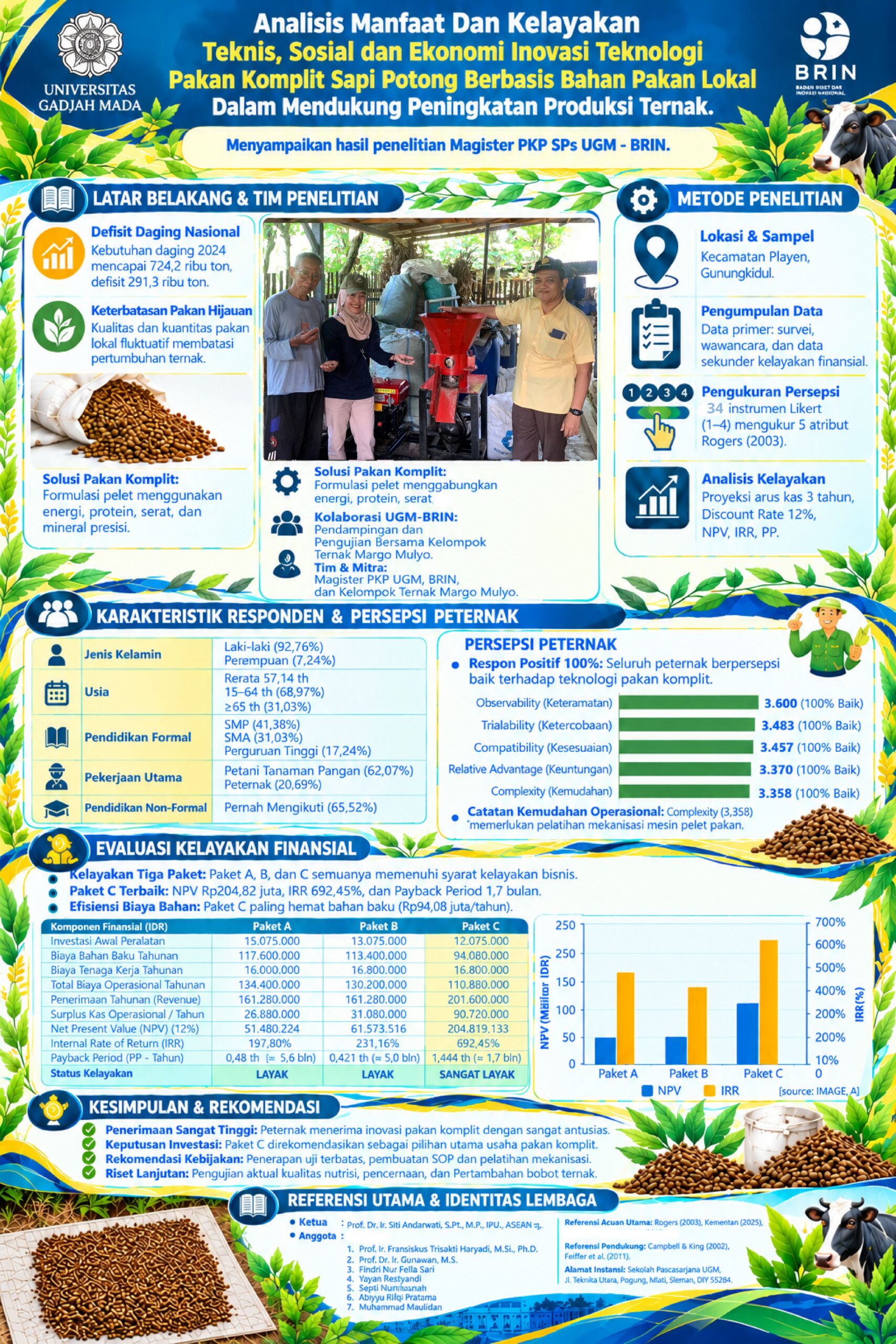
This complete feed technology combined energy, protein, fiber, and mineral sources in precisely formulated proportions and processed into pellet form.The use of locally available ingredients not only reduces production costs but also offers a sustainable solution to the shortage of forage.The study demonstrates the success of this technology in several aspects: a) Farmer Perceptions (100% Positive). A total of 34 Likert-scale assessment items, measuring the five innovation attributes proposed by Rogers (2003), revealed that 100% of the farmers welcomed the technology and expressed positive responses toward its five attributes: observability, trialability, compatibility, relative advantage, and complexity (easy to use); b) Excellent Financial Feasibility An evaluation of three feed formulations demonstrated that all options were financially viable. The most efficient and profitable formulation, which achieved the highest savings in raw material costs, generated a Net Present Value (NPV) of IDR 204.82 million, an Internal Rate of Return (IRR) of 692.45%, and a remarkably short Payback Period of just 1.7 months.
Moving Forward
Although farmers have demonstrated an overwhelmingly enthusiastic response to this technology, its implementation requires continuous assistance, particularly with training in the operation of feed pellet-making machinery and the development of Standard Operating Procedures (SOPs). With appropriate policy support and structured pilot trials, this locally sourced complete feed innovation has significant potential to be replicated in other regions across Indonesia, contributing to the achievement of national food self-sufficiency.
Contribution to the Sustainable Development Goals (SDGs)
This initiative supports the achievement of the following Sustainable Development Goals: SDG 2: Zero Hunger By improving feed efficiency and increasing livestock weight gain, this technology contributes to strengthening national food security with increased domestic beef production and reduced dependence on imported beef. SDG 8: Decent Work and Economic Growth The financial analysis, which indicates a high rate of return (IRR of 692.45%), suggests that complete feed pellet production within livestock farmer groups can generate significant income and create employment opportunities in rural communities. SDG 12: Responsible Consumption and Production Optimizing the use of locally available feed resources promotes a more efficient and environmentally friendly livestock production system while minimizing negative impacts on ecosystems. SDG 17: Partnerships for the Goals. This program represents a concrete example of cross-sector collaboration among a higher education institution (UGM), a research agency (BRIN), and a grassroots livestock farming community (the Margo Mulyo Livestock Farmers Group) in transforming scientific knowledge into tangible benefits for society.
Author: Prof. Siti Andarwati Editors: Arni W, Ana A