
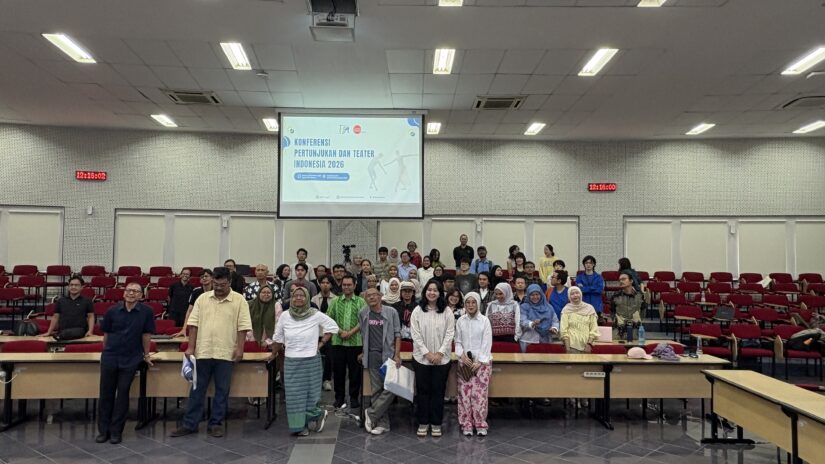
Yogyakarta, 4th November 2026 — Performing arts and theatre are not merely spaces for artistic expression, but also mediums in which bodily experiences, identity, power relations, social change, and human relationships with the environment can be explored. These dimensions were the focus of the Indonesian Performance and Theatre Conference 2026, held on 3rd–4th November 2026. The event was supported by the Indonesia Dramatic Reading Festival (IDRF) in collaboration with the Media and Cultural Studies Program, Graduate School, Universitas Gadjah Mada (UGM). The conference was held in a hybrid format on the first day at the Auditorium, 5th Floor, Graduate School Building, UGM, and continued online via Zoom on the second day.
Carrying the overarching theme “Body and Metaphor,” the conference provided a meeting space for academics, researchers, arts practitioners, and students to discuss developments in performing arts from various perspectives. On the first day, Tuesday (3rd November), the event opened with a discussion session entitled “Body and Metaphor,” featuring Prof. Dr. Amalinda Savirani, S.IP., M.A. as the keynote speaker, alongside Dr. Ikun Sri Kuncoro and Irfanuddien Ghozali as discussants. The discussion explored the use of the body and metaphor in performance practices, as well as how bodily experiences can be understood as part of social and cultural constructions.
The first day’s program also featured the launch of the book Dari Bibir Panggung Seni Pertunjukan & Kebudayaan dalam Kacamata Pertunjukan: Bunga Rampai Tulisan (From the Lips of the Performance Stage: Performing Arts and Culture through the Lens of Performance: An Anthology of Essays). The session featured Silvia Purba as the book’s editor and Khotibul Umam as moderator. The book launch served as an effort to expand the documentation and exchange of ideas concerning performing arts and their relationship with culture. The discussion continued with a session entitled “From Movement to Screen,” featuring Prof. Dr. Deny Tri Ardianto, S.Sn., Dipl. Art., and moderated by Dr. Elok Santi Jesica, S.Pd., M.A. The session examined the transition of movement expression from the stage to audiovisual media, including how camera work, editing, and visual composition can generate new meanings in performance.
On the second day, Wednesday (4th November), the conference continued online with three discussion sessions exploring the themes of the body, metaphor, and knowledge. The first session, entitled “Bodily Experiences,” was moderated by Juwita Wardah, a master’s student in the Media and Cultural Program at UGM. The session featured Nila Dianti, who presented research on experiences of bipolar disorder with an autoethnographic approach to performance art; Titis Widjayanti, who discussed the bodies of women migrants in urban spaces; and Nanosuharno, who examined critiques of shallow decolonial aesthetics and colonial body ethics in contemporary Indonesian performance practices.
The second session, “Metaphor and Adaptation across Media,” was moderated by Samuel Rihi, a doctoral student in the Media and Cultural Program at UGM. The discussion featured Rio Dwi Febriansyah and M. Pramudya Firmansah, who presented their research entitled “When the Mine Becomes a Stage: Reading Tombs, Sacredness, and Community Practices in a Galian C Mining Area.” Bayu Citra Raharja subsequently explored the relationship of musical composition, artificial intelligence, and hyperreality, while Nuratika examined the body as an archive of wounds with a discussion of metaphors of pain, resilience, and women’s aspirations in the work Fajar Memeluk Mentari.
The third session, entitled “Ecology of Knowledge,” was moderated by Sora Gia, an alumna of UGM’s Performing Arts and Visual Arts Program. The session featured Darryl Haryanto and Tara Mecca Luna, who presented “WETWARE<3: A Performance Note.” Muhammad Ade Putra then discussed the river as a performance space and the metaphor of motherhood in “Amakku Subayang, Subayang Amakku.” The session concluded with Sarah Tjia’s presentation, entitled “When Wounds Are Interpreted as Threats: An Autoethnography of Kuntilanak under the Dictates of Authority and Capital Control.”
The conference concluded with an Observer’s Reflections session featuring Ferial Afiff, an arts practitioner, and Jejen Jaelani, a doctoral student in the Media and Cultural Program at UGM, moderated by Khotibul Umam. This final session provided an opportunity to reflect on the ideas and issues discussed throughout the conference, while offering critical perspectives on the development of performing arts and theatre in Indonesia.
The diversity of topics discussed demonstrated that the body in performance is not merely an instrument for producing movement or artistic expression. It is also a site where experiences, memories, identities, wounds, and power relations unfold. Similarly, metaphor functions not only as an aesthetic device but also as a means of examining social, environmental, technological, and cultural issues. The autoethnographic approaches, critical analysis, and cross-media exploration showed the conference highlighted the potential of performing arts as a space for knowledge production that connects personal experiences with collective concerns.
The two-day conference also demonstrated the importance of collaborative spaces of academics, arts practitioners, researchers, and students in advancing discourse on performing arts in Indonesia. The diversity of perspectives allowed theatre and performance practices to be examined not only through their artistic dimensions, but also with approaches drawn from cultural studies, media studies, politics, gender, technology, and ecology. For the academic community, such gatherings create opportunities for interdisciplinary research while strengthening the relationship between artistic practices and knowledge production.
The Indonesian Performance and Theatre Conference 2026 showed the Media and Cultural Program at UGM, together with its organizing partners, contributed to the development of dialogue spaces that brought artistic practices into conversation with academic reflection. The conference is expected to broaden perspectives on performing arts as an evolving cultural practice and as a medium for understanding social change and diverse human experiences.
Author: Khoirul Mujazanah