
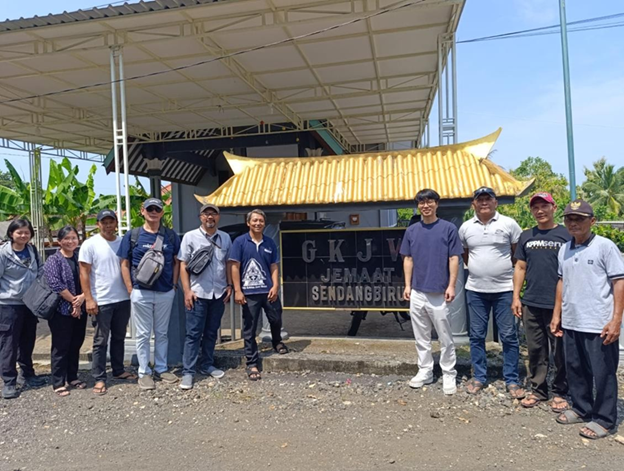
Yogyakarta, 4th February 2026 — Discussion on Indonesian Migrant Workers (Pekerja Migran Indonesia/PMI), the dominant narratives often revolve around numbers—the amount of remittances sent home, success stories of building houses, or, conversely, tales of failure abroad. However, a recent study conducted by the Graduate School of Universitas Gadjah Mada (UGM) uncovers much deeper layers of experience. Migration is not merely understood as physical mobility for economic gain, but also as a spiritual and social journey that reshapes worldviews, faith, gender relations, and community networks of migrant workers, even after they return to Indonesia.
The study was initiated by Dr. Leonard Chrysostomos Epafras from the Interreligious Studies Doctoral Program (IRS), UGM Graduate School, and conducted in 2025 UGM Graduate School Research Grant. Together with Hongsok Lee, M.Div., the research team conducted a comparative study by interviewing two groups of former PMI—those who had worked in South Korea and those who had worked in Hong Kong. This approach enabled the researchers to closely examine how economic conditions, migration policies, and gender dynamics shape religious expression and social resilience among Indonesian migrant workers.
“Migration experiences generate economic remittances, and also shape new ways for workers to understand faith, identity, and social solidarity, the impacts of which become even more evident when they return to their home communities,” said Dr. Leonard Chrysostomos Epafras.
In South Korea, which has become one of the main destinations for male Indonesian migrant workers through the Government-to-Government (G-to-G) scheme, economic stability plays a significant role in shaping religious expression. With relatively high incomes, particularly in manufacturing, fisheries, and industrial sectors, migrant workers are able to consolidate their economic capital into collective strength. The study records the establishment of more than 63 Indonesian mosques in South Korea, funded and independently managed by migrant worker communities. This phenomenon is understood as a form of transnational religious replication, in which religious practices, structures, and traditions from Indonesia are re-established abroad. These mosques function not only as places of worship, but also as symbols of existence, spaces for social interaction, and a “second home” within a different cultural environment.
A strikingly different situation is found among Indonesian migrant workers in Hong Kong, who are predominantly women employed as domestic workers. With limited wages, restricted mobility, and no legal status to establish formal places of worship, their religious expression does not materialize in physical infrastructure. Instead, these limitations give rise to functional and adaptive religious practices. Public spaces such as city parks, building corridors, shelters, and online platforms are utilized as spaces for worship, spiritual reinforcement, and social solidarity. In this context, faith serves as a source of psychological resilience and a means of survival amid work-related pressures and social vulnerability.
One of the key findings of the study is the conceptualization of religion as an “invisible infrastructure.” Within secular and competitive social systems, religion functions as an anchor of identity, a safe space, and a foundation for interfaith solidarity. The research also reveals processes of identity negotiation, in which migrant workers adapt to certain aspects—such as work patterns or everyday cultural practices—without fully relinquishing their religious identity and sense of togetherness with fellow Indonesian workers.
Upon returning to their home regions in East Java and Central Java, former PMI bring back diverse experiences. Those returning from South Korea generally come home with strong economic capital and play active roles as local economic drivers. Meanwhile, former PMI from Hong Kong bring what is described as social remittances, including legal awareness, organizational experience, and the courage to speak out. Many of them subsequently transform into village activists, mentors for prospective migrant workers, and agents of education in preventing human trafficking, turning their migration experiences into assets for grassroots social change.
Ultimately, the study underscores that behind the contribution of foreign exchange earnings, there are individuals striving to preserve faith, identity, and hope in foreign lands. When migrant workers return home, they bring not only money, but also resilience, social knowledge, and a spirit of change that is invaluable to their home communities.
Source: Leonard C. Epafras
Editor: Asti Rahmaningrum
Photo: Leonard C. Epafras