
Yogyakarta, 4th February 2026 — Climate change is no longer merely a scientific discourse, but a reality that is increasingly felt in the daily lives of Indonesian communities. Unpredictable rainfall patterns and declining groundwater levels pose serious threats to sustainability and public health. In response to these challenges, a research team from the Graduate School of Universitas Gadjah Mada (UGM), led by Prof. Dr.-Ing. Ir. Agus Maryono, IPM., ASEAN Eng., released strategic research findings in 2025 focusing on water resource management as a key climate change adaptation strategy.
The study, entitled “A Study of Options for Utilizing Groundwater and Harvesting Rainwater to Improve Health and Well-Being in Response to Climate Change in Indonesia,” examines two regions with contrasting hydrological characteristics yet similar challenges, namely Gunungkidul Regency and Semarang Regency. The water management in many areas has been dominated by a drainage-oriented paradigm that views rainwater as a threat that must be quickly discharged into rivers and the sea. The team advocates, through this research, a paradigm shift toward rainwater harvesting as a strategic resource that can be managed sustainably.
“Rainwater harvesting is an adaptive solution that not only addresses the water crisis caused by climate change, but also strengthens community health, well-being, and self-reliance in a sustainable manner,” said Prof. Agus Maryono. According to him, rainwater should be regarded as a blessing rather than a disaster. With the application of appropriate technologies, rainwater can be processed into a clean water source that supports public health, reduces dependence on increasingly deep and poor-quality groundwater, and can be utilized for various needs, including sanitation and livestock farming.
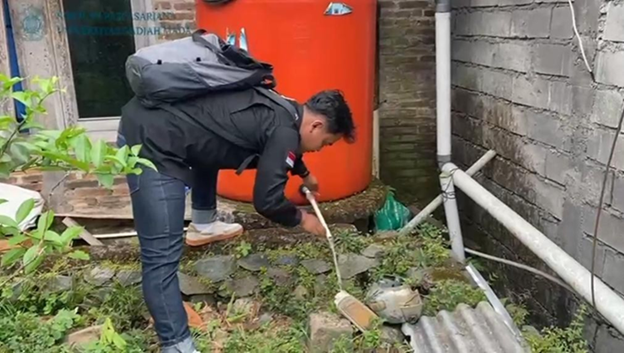
Gunungkidul Regency frequently experiences drought during the dry season, and Semarang Regency as a peri-urban area facing high water demand pressures, the research team conducted field surveys and participatory dialogues with local governments and community groups. The findings reveal strong community enthusiasm for adopting rainwater harvesting technologies as a practical solution to water scarcity. In addition to increasing access to clean water, the implementation of this system also enhances community resilience to extreme weather events. During the rainy season, water can be stored to reduce runoff and flood risks, while during the dry season, water reserves remain available. The use of rainwater harvesting systems also helps reduce electricity consumption, lower carbon emissions, and create a healthier and more productive environment. In the Semarang research site, rainwater is even utilized to support livestock sanitation, directly contributing to improved hygiene and community well-being.
The final report of this research grant recommends that community-based rainwater harvesting models be replicated across various regions in Indonesia as part of a strategy toward national water self-sufficiency. The research team, consisting of Prof. Himawan Tri Bayu Murti Petrus, Muhammad Sulaiman, D.Eng., and young researchers Adnin Musadri, Daniel Wolo, and Pratama Tirza, is optimistic that this approach is not only technically relevant but also aligned with efforts to achieve sustainable development amid increasingly complex climate change challenges.
Source: Agus Maryono
Editor: Asti Rahmaningrum
Photo: Agus Maryono