
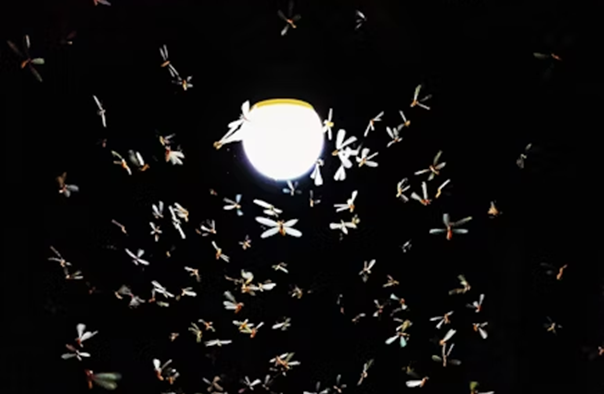
Yogyakarta, 13th January 2026 — Increasingly bright artificial lighting at night does more than illuminate the surroundings; it also poses serious threats to insect life, particularly moths. A recent study conducted in Sleman Regency, Yogyakarta, reveals that rising levels of nighttime artificial light are correlated with a decline in both the abundance and diversity of moths. This is a concerning finding, as these nocturnal insects play a crucial role in maintaining plant fertility and ecological balance.
Moths are often regarded as ordinary insects and are sometimes even considered pests. However, they serve as important natural pollinators for various plant species, much like bees, and act as a vital food source for birds and bats. Unfortunately, their existence is increasingly threatened by light pollution resulting from human activities.
The study was carried out by Dr. Ir. Much. Taufik Tri Hermawan, S.Hut., M.Si., together with Marwan Rajab, S.Hut., and Dwi Prayoga Ade Sarlita, S.Si., from the Environmental Science Master’s Program, Graduate School of Universitas Gadjah Mada (SPs UGM). The research team monitored moth populations across several areas in Sleman over a period of several months. The results show that areas with higher levels of nighttime illumination have significantly fewer moths and experience a marked decline in species diversity.
Dr. Taufik Tri Hermawan, as the lead researcher, explained that light pollution has a substantial impact on nocturnal insects. “Moths rely heavily on dark conditions to carry out their natural activities. Excessive artificial light at night disrupts their navigation and reproductive processes, causing their populations to continue to decline,” he said.
A decrease in moth populations may lead to serious cascading effects, particularly for agriculture and the environment. Reduced pollination activity can result in lower plant fertility and decreased agricultural productivity. In addition, disruptions to the food chain threaten the survival of other wildlife, such as birds and bats, that depend on moths as a primary food source.
Nevertheless, the researchers emphasized that the proposed solutions do not need to be extreme. Communities can begin contributing through simple measures, such as using lower-intensity lighting at night, turning off unnecessary lights, and creating dark zones around agricultural areas and green open spaces.
Source: Taufik Tri Hermawan
Editor: Asti Rahmaningrum
Photo: Unsplash