
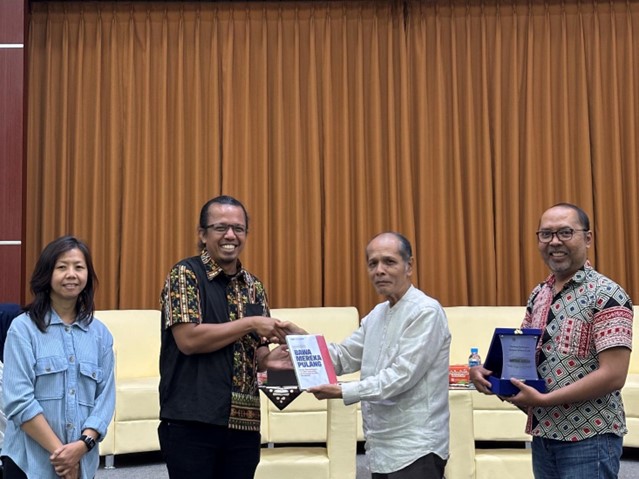
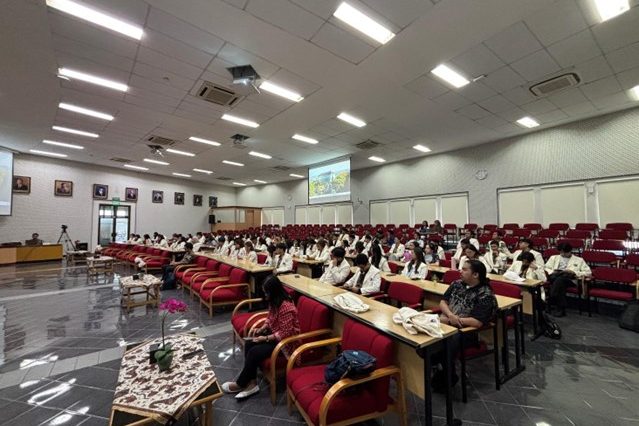
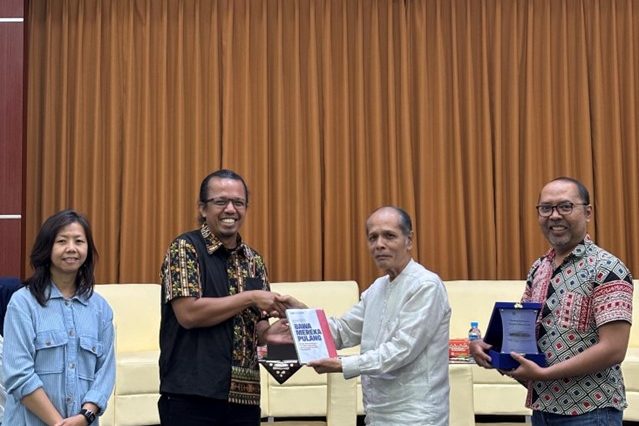
The Peace and Conflict Resolution Master Program (MPRK), Universitas Gadjah Mada (UGM), welcomed a study visit from Universitas Kristen Satya Wacana (UKSW) Salatiga at the Graduate School Auditorium on Tuesday 9th December. The visit was attended by approximately 90 undergraduate students from UKSW’s International Relations program and aimed to deepen their understanding of peace and conflict studies.
MPRK UGM, during the visit, facilitated a discussion on the development of International Relations (IR), particularly the shift in security paradigms from traditional military-centered approaches to the concept of human security. The session was delivered by Mohtar Masoed, chief of Study Interest at MPRK UGM, and moderated by Dody Wibowo, Head of Quality Assurance.
Mohtar explained that following World War I and II, the discipline of International Relations underwent significant changes with the emergence of non-traditional security issues. Security is no longer viewed solely from a military lens but encompasses legal, economic, social, and humanitarian dimensions. In this context, peace and conflict resolution studies play a crucial role within the multidisciplinary framework of IR.
“In the past, security issues were primarily addressed through military approaches. Today, many security challenges can be resolved through non-military means. This is where International Relations and human security studies become highly relevant,” Mohtar stated.
He also emphasized that graduates of International Relations are not limited to diplomatic careers but have broader opportunities in fields related to human security. Similarities in curriculum and academic focus of UKSW and MPRK UGM were highlighted as potential avenues for future academic collaboration.
Representing UKSW, Kris, a lecturer in International Relations, expressed appreciation for the study visit. He noted that discussions on human security encouraged students to become more attentive to issues in their immediate surroundings before engaging with global-level problems.
“Before looking at international issues, students need to be sensitive to problems that exist close to them. This discussion was very effective in shaping that perspective,” he said.
The discussion was further enriched by Glory Prayoga, an International Relations lecturer at UKSW and an alumnus of MPRK UGM. He highlighted human security challenges in Salatiga City, which he categorized as structural violence. Long-standing vulnerabilities in economic, environmental, and health aspects, he explained, have gradually become normalized within the community.
Concluding the session, MPRK UGM lecturer Titik Firawati emphasized that the concept of human security helps redefine the meaning of “security” beyond the absence of war. She illustrated this through the case of India’s economic liberalization in the 1980s, which led to social changes such as rising marriage dowry demands—an example of non-physical insecurity experienced by society.
The study visit served as a platform for knowledge exchange and the dissemination of peace values among students. MPRK UGM with academic dialogue such as this, hopes to contribute to fostering a more peaceful, critical, and just mindset among younger generations.
Writer: Yeti Susilowati