
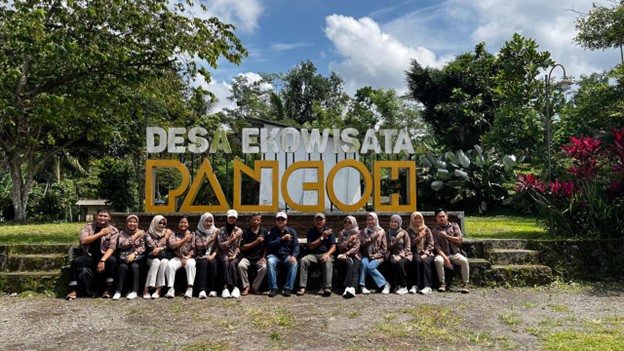
Students of the Master of Tourism Studies (MKP) Program at the Graduate School of Universitas Gadjah Mada carried out a Field Study for the Community-Based Tourism course on Wednesday (10/12). The field study conducted visits to Pancoh Ecotourism Village and Pulesari Tourism Village in Turi District, Sleman Regency. The activity was attended by 11 students of the 2025 cohort as part of practical learning on the implementation of community-based development in tourism destination management.
This field study served as a platform for students to observe firsthand how local communities manage tourism villages based on natural and cultural resources. Previously, these concepts were mainly explored on class discussions and theoretical materials, making this activity an important opportunity for students to deepen their understanding through direct field experience.
The activity began with a visit to Pancoh Ecotourism Village, where students received a presentation from Mr. Ngatijan, the village tourism manager. In his presentation, he emphasized the importance of community collaboration in maintaining the sustainability of tourism villages. “A tourism village can only grow when its community gets involved and feels a sense of ownership. That is the key,” he said. The session was followed by a discussion and the implementation of the Snapshoot Assessment of the Sustainable Tourism Observatories, which served as part of the students’ observation assignment.
The group then continued to Pulesari Tourism Village, where students attended a presentation delivered by Mr. Sarjana, the local tourism manager, on developing attractions based on local potential—particularly salak (snake fruit), traditional culture, and the application of sustainable tourism destination principles. Activities in Pulesari also included hands-on practice through an educational tourism package, such as salak picking, learning salak cultivation, and exploring various salak-based products.
Throughout the activity, students had the opportunity to engage directly with village managers, identifying strategies for inclusive and sustainable destination management. The insights gained will be compiled into a field observation report as part of the course assessment.
The field study was supervised by the course instructors, Drs. Hendrie Adji Kusworo, M.Sc., Ph.D. and Dr. Ir. Muhamad, S.T., M.T., IPU., ASEAN.Eng., who emphasized the importance of empirical experience in understanding the dynamics of community-based tourism destinations.
Students, through this activity, are expected to apply the concept of community-based development and evaluate its implementation within the context of sustainable tourism destinations in accordance with the Ministry of Tourism and Creative Economy Regulation No. 9 of 2021.
Writer: Asti Rahmaningrum