
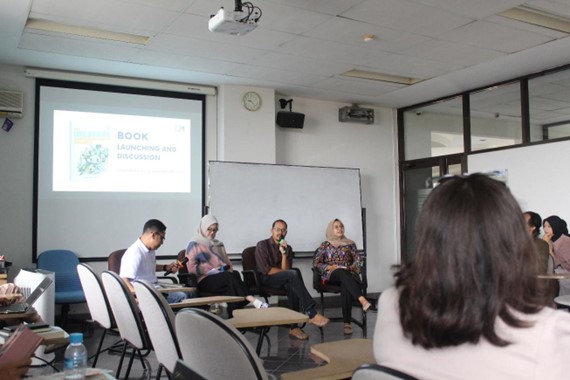
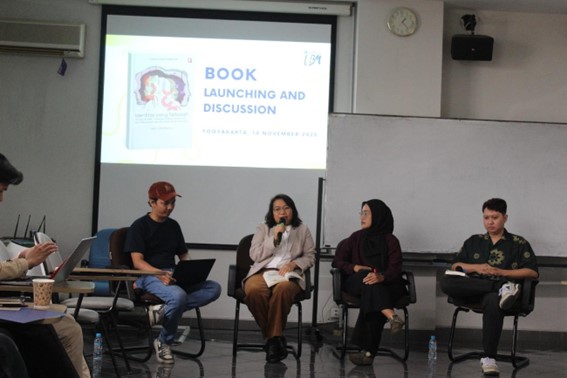

Yogyakarta, 14th November 2025 – Media and Cultural Programs, The Graduate School, Universitas Gadjah Mada facilitated an academic dialogue through a Book Launching and Discussion event held on Friday (14/11) in Room 307 of the Graduate School. This event was an important part of the 4th Lustrum celebration series of Media and Cultural Studies, as well as a form of appreciation for the latest scholarly works produced by its lecturers, researchers, and wider network.
Three books launched at the event were “Kala Lokal dan Global Berjumpa dalam Praktik Budaya dan Media di Indonesia” (editor: Arifah Rahmawati), “Pertemanan dan Pesohor di Ruang Siber” (editor: Budiawan), and “Identitas yang Terbelah” (editor: Archie Raditya). These works represent the broad scope of Media and Cultural Studies scholarship—ranging from everyday cultural dynamics, social relations in digital spaces, to debates on identity in contemporary Indonesian society.
The event began at 08.00 WIB with participant registration, followed by the opening session led by the MC, Ave. Welcoming remarks were delivered by Rivi Handayani, Secretary General of Katabumi, who emphasized the importance of knowledge production and cross-community collaboration in strengthening the academic ecosystem of Media and Cultural Studies. After the remarks, each editor briefly introduced their book through a symbolic launching procession and presented copies to the program’s representative, Ratna Noviani, marking the start of the discussion series.
The first session highlighted the book “Kala Lokal dan Global Berjumpa dalam Praktik Budaya dan Media di Indonesia.” This book explores how globalization influences cultural practices in various local contexts—from culinary culture and urban spaces to cultural consumption. One essay discusses how food becomes a site of identity negotiation amid global mobility. Phenomena such as the presence of burgers in Jakarta, sushi in Paris, or nasi goreng in Amsterdam illustrate encounters of global tastes that simultaneously risk cultural homogenization. In Yogyakarta, areas such as Prawirotaman demonstrate the tension between the global and the local, as traditional eateries coexist with modern restaurants and respond to international tourists with English-language menus or new interior concepts. The essays in this volume reveal how cultural identities are negotiated on hybridity, adaptation, and subtle forms of resistance to global dominance.
The second session focused on “Pertemanan dan Pesohor di Ruang Siber.” This book explores how the concept of pure relationship (Giddens, 1992) manifests in contemporary relations take place across offline and online spaces. The authors argue that debates about the “authenticity” of friendships—whether offline or online—are no longer relevant, as both have their own dynamics and challenges. The book also examines distinctions between traditional celebrities and internet celebrities who depend on virality and visibility. The emergence of digital public figures reshapes how intimacy is constructed through performativity and identity curation. Visual approaches such as screenshots are used to clarify interaction practices in cyberspace, making this book an important perspective for understanding today’s social media phenomena.
The third session presented a discussion on “Identitas yang Terbelah,” examining identity, representation, and power relations in Indonesia. The book also connects fandom practices as spaces of meaning-making. The Love Live! fan community, for example, illustrates how fans act as cultural producers through artworks, online discussions, and fan art that reflects semiotic democracy. However, such creativity is not entirely free, as it remains situated within the shadow cultural economy constrained by the cultural industries. Analyses of doujinshi and yuri works within the fandom open discussions about resistance to dominant norms and affective expressions in popular cultural spaces.
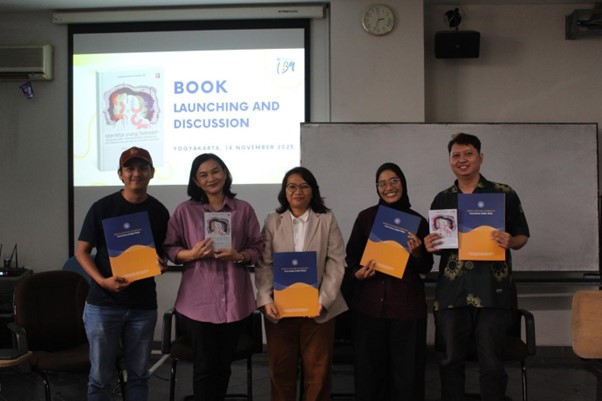
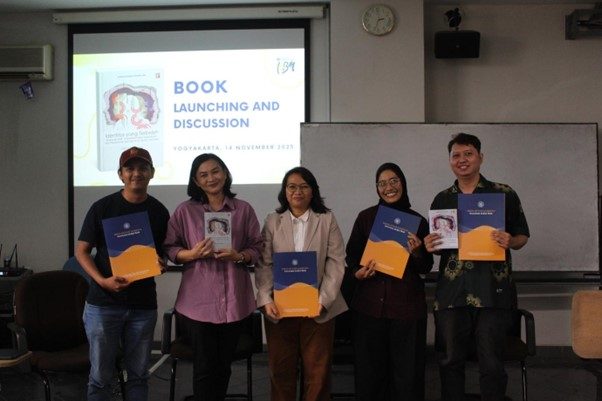
The event, which lasted until 14.15 WIB, concluded with certificate presentations and a group photo session. The entire series of activities was documented by the Media and Cultural Studies PDD Team. The Media and Cultural Studies Program, through this event, hopes to continue fostering a critical, creative, and inclusive intellectual climate, and to strengthen collaboration between the academic community and broader knowledge networks.
Author: Khoirul Mujazanah