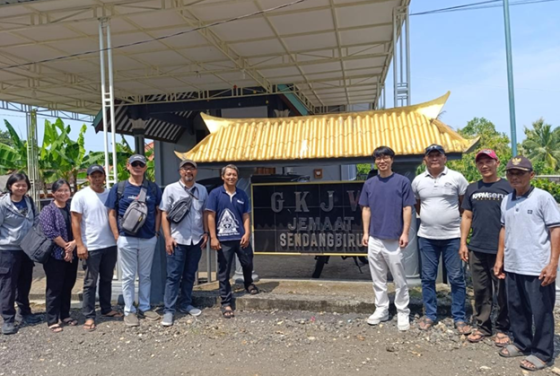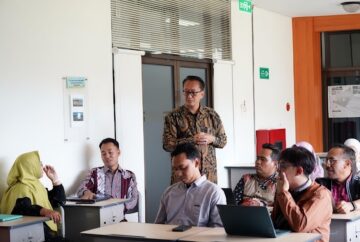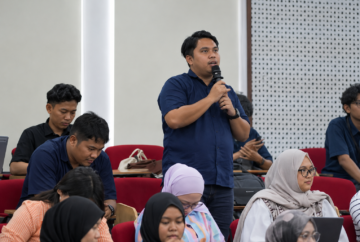
Yogyakarta, November 14th 2025 – A change in mindset is the core of successful environmental rehabilitation. This is no longer just about planting trees to meet land cover targets, but planting hope for a sustainable harvest. This valuable lesson was learned by students of the Master of Environmental Management (MPL) program at the UGM Graduate School during a field study on Saturday, November 8th 2025. This activity was designed to bridge the gap of classroom theory and on-the-ground reality, especially for the Watershed (DAS) Ecosystem Management course. Guided by the lecturer, Dr. Muhammad Anggri Setiawan, S.Si., M.Si., the students went directly into the field to trace the ecosystem of the Progo River Watershed from upstream to downstream. “Watershed management is an applied science,” explained Dr. Anggri during the activity. “Students need to see firsthand how biophysical conditions upstream, such as land cover and erosion, can directly affect socio-economic conditions downstream. Today, we are doing just that.”
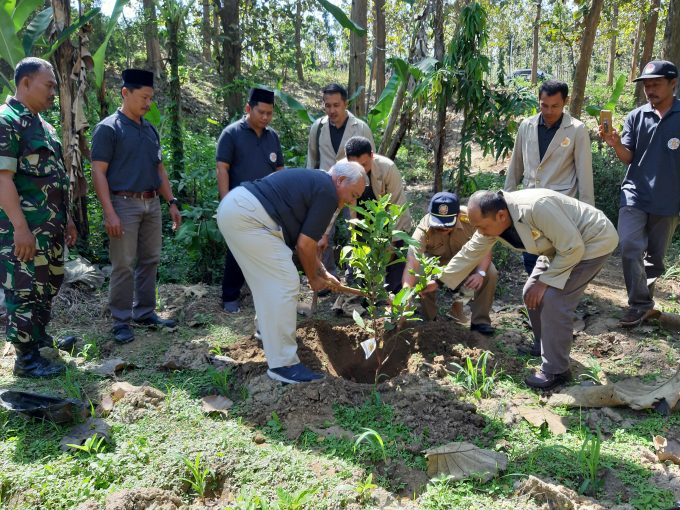
The journey began in the upstream region, specifically in Gerbosari Village (Samigaluh) and Banjarasri Village (Kalibawang). In this hilly area, students carefully observed the rehabilitated lands managed as part of a partnership program by PT Bharinto Ekatama. Land that was once critical now appears green with productive plants. Afnan Syah Hananto, one of the students, appreciated this unusual rehabilitation approach. “It’s fascinating to see land being rehabilitated with productive plants. This program doesn’t just plant timber trees, but chooses high-economic-value fruit species like avocado, durian, and longan. This proves that ecological improvement can go hand-in-hand with community economic enhancement,” Afnan said.
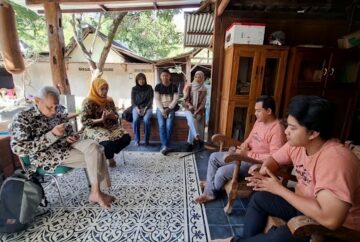
The visit was not limited to physical observation. The most important part was the interaction and in-depth interviews with farmers who are members of the local Forest Farmers Group (KTH). It was here that the students discovered the core of empowerment. A deep impression was felt by Saadah Arum Abiyanti, who spoke directly with KTH members. According to her, the biggest success of this program is the shift in mentality. “The most touching part was hearing directly from the farmers,” said Saadah. “They shared that while they previously tended to plant timber with a ‘plant once, cut down’ system, they have now switched to seasonal fruit crops. This change is an indicator of successful empowerment, as the community shifts to more environmentally friendly and annually sustainable practices.” After understanding the dynamics upstream, the journey continued towards the estuary in the Pandansimo Bridge area. In this downstream region, the observation focus shifted to the condition of the aquatic and coastal ecosystems. Students observed the impacts of sedimentation and the condition of the mangrove ecosystem as an evaluation of the link between upstream management and its downstream effects.
“Here we were prompted to ‘connect the dots’,” shared Reviana Fadhilla Choirunnisa, another student. “Upstream, we saw successful rehabilitation practices, and downstream, we evaluated their impact on the coastal ecosystem. This visit truly demonstrates that a watershed is a single, integrated unit that cannot be managed in isolation.” Concluding the series of activities, Dr. Anggri Setiawan summarized that the key to successful Progo Watershed management lies in a triple-helix synergy. “This activity proves the importance of synergy between a committed private sector (PT Bharinto Ekatama), active community participation (KTH), and academic support (UGM) to create real sustainable natural resource management,” he concluded.
Author: Berlian Belasuni