
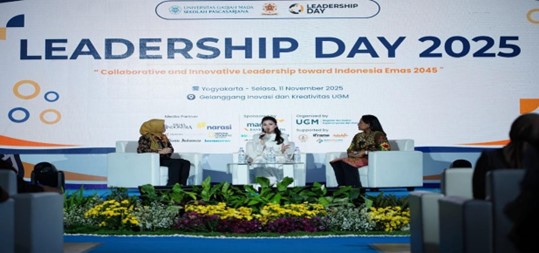
Yogyakarta, 11th November 2025 — Leadership Day 2025, organized by the Graduate School of Universitas Gadjah Mada (SPs UGM) through the Leadership and Policy Innovation (MDKIK) Master and Doctoral Program, together with the Alumni Association of the Master’s and Doctoral Program in Leadership and Policy Innovation (Kapimgama). The session featured two inspiring women: Prof. Dr. Wening Udasmoro, S.S., M.Hum., DEA., Vice Rector of UGM, and Sherly Tjoanda, Governor of North Maluku. The discussion offered a profound reflection on the experiences, policies, and real impacts of women’s leadership in building a more inclusive Indonesia.
The moderator opened the discussion by connecting it to the vision of Golden Indonesia 2045 and the crucial role of women’s leadership in establishing it. Prof. Wening, responding to this, emphasized that leadership becomes meaningful when it is grounded in awareness of social inequality and a vision of inclusivity. “Leadership becomes important when we clearly understand our position regarding social disparities and carry a vision and mission of inclusivity,” she remarked.
She explained that this inclusive spirit is reflected in various UGM policies, such as handling sexual violence cases, providing support for students with disabilities, and implementing affirmative policies for students from diverse regions. “UGM is a pioneer in inclusive policies, from addressing sexual violence and supporting students with disabilities to affirmative admissions. All of these rooted from the belief that the university must be a space for everyone to grow,” she added.
Meanwhile, Sherly Tjoanda stressed that leadership is not about power or having the loudest voice, but about the ability to listen and understand people’s needs.
“Leadership isn’t about who speaks the loudest, but who listens, solves problems, and understands the people’s needs,” she affirmed.
She explained that empathy lies at the heart of leadership capable of generating innovative policies and building public trust. “Empathic leadership is key. Empathy drives innovation in policymaking, which in turn builds people’s trust in their leaders,” she said.
In response, Prof. Wening added that women’s empathy is not simply an innate trait but a result of experiences and the ecosystem that shapes it. “Women’s empathy is not merely natural — it’s formed through repeated experiences and the surrounding environment. It’s about building a shared ecosystem of empathy,” she explained.
The discussion also touched upon the importance of recognizing women’s movements and involving men as allies in the fight for equality. Prof. Wening noted that while women’s movements have existed since the 19th century, social recognition and collective support only began to grow in the third and fourth waves. “The women’s movement has been around for a long time, but recognition came much later. That’s why this movement must involve men so it becomes broader and not exclusive,” she said.
Sherly added that women should not wait for leadership spaces to be offered but should have the courage to create their own. “We don’t have to wait for space to be given — we must create it. Women’s leadership is not a competition with men; it’s about balance. Wherever we are, we can lead and make an impact,” she stated.
The session grew warmer as Sherly shared her personal story of leading with the nurturing approach of a mother. “I lead in my own way — like a mother. I listen, I advise, I seek solutions. As women, we don’t have to be like men. We can be gentle yet firm,” she said.
Closing the session, Prof. Wening emphasized the importance of recognizing women’s experiences in leadership, as every journey holds valuable lessons.
“Women’s experiences are often overlooked, yet they hold immense value. We must give recognition to these stories so they can inspire the next generation,” she concluded.
This talk show was one of the highlights of Leadership Day 2025, reaffirming that empathy, inclusivity, and the courage to create space are the essence of women’s leadership.
From the UGM campus, the voices of women once again resonated — a reminder that true leadership is not about authority, but about the ability to understand, to listen, and to bring meaningful change.
Writers: Naufal Sabda Auliya and Rosyida Indah Mawarni Editor: Arfikah Istari