
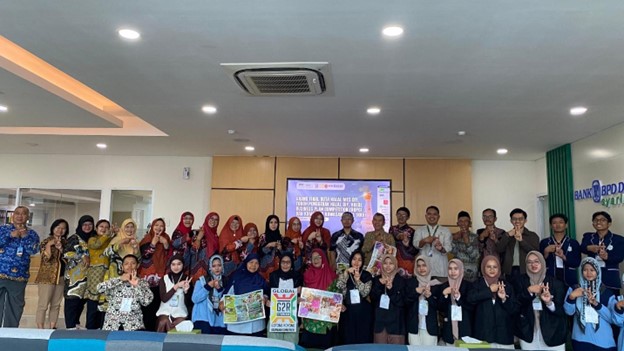
(Yogyakarta) — From community dialogue forums to international academic stages, the efforts to build an inclusive and sustainable halal economic ecosystem continue to gain momentum. The Masyarakat Ekonomi Syariah (MES) of Yogyakarta Special Region (DIY), as part of the Road to the 3rd International Conference on Islamic and Halal Economic Studies (ICIHES) 2025, together with the Doctoral Program in Islamic Economics and Halal Industry (PIIH) of the Graduate School, Universitas Gadjah Mada (UGM), held four grand final events combining innovation, education, and community empowerment on Tuesday, October 28th 2025.
The event, held at BPD DIY Syariah, brought together various sectors—students, university scholars, MSME players, mass organizations, and academics—with four main activities: the Grand Final of MES DIY Halal Ambassador, Halal Movement Figure of DIY, Halal Business Plan Competition (HBPC), and Commitment to Halal Zones (KKH) in collaboration with G2RT Tetrapreneur.
These four events were more than celebrations of achievement; they served also as showcases of collective spirit and the redefinition of halal contribution. The Halal Ambassador program went beyond products, focusing on personal embodiment of halal values. The Halal Movement Figure recognized grassroots leaders who mobilize their communities in daily life. HBPC introduced a collaborative approach of young teams and real local MSME clients, while KKH encouraged halal zone practices based on cross-community collaboration at the village level—a breakthrough in mapping the halal ecosystem in DIY.
Dr. Reni Rosari, M.B.A., Chief of the Islamic Economics and Halal Industry Doctoral Program at UGM, stated that the program’s participation represents a concrete academic contribution to contextual and impactful halal economic practices.
“ICIHES is not merely a scientific forum, but a bridge of theory and the society’s real needs,” she emphasized.
The event also received strong support from the Islamic finance sector, including BPD DIY Syariah, highlighting the importance of strengthening the halal ecosystem not only in terms of conceptual literacy but also in its practical implementation in everyday life.
The judging session involved experts from various sectors—academics, halal activists, business practitioners, and government representatives. The finalists will return for the award ceremony on November 4th 2025, during the 3rd ICIHES 2025 at the Marriott Hotel Yogyakarta, marking the peak of the international conference themed “Integration of Knowledge, Industry, and Policy in Halal Economics and Finance.”
The Road to ICIHES 2025 initiative reflects that the halal economy is about regulations and certification, and also a space for creativity, collaboration, and community empowerment. From Yogyakarta, a strong message is sent: the future of the halal economy lies in multi-stakeholder synergy—academia, communities, government, and industry—moving together with a vision of ethical progress.
This event aligns with the implementation of SDG 4: Quality Education; SDG 8: Decent Work and Economic Growth; and SDG 17: Partnerships for the Goals.
Writer: Dr. Reni R.
Editor: Arni Wistriatun