
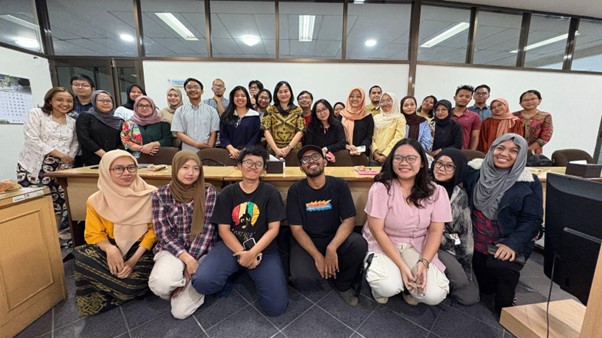
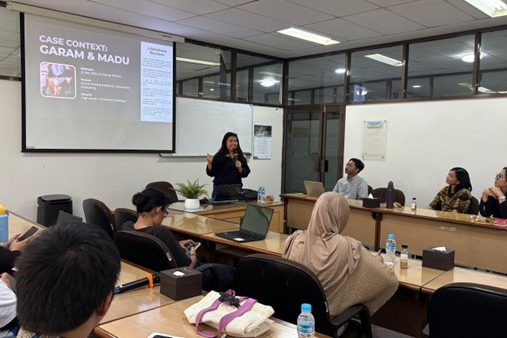
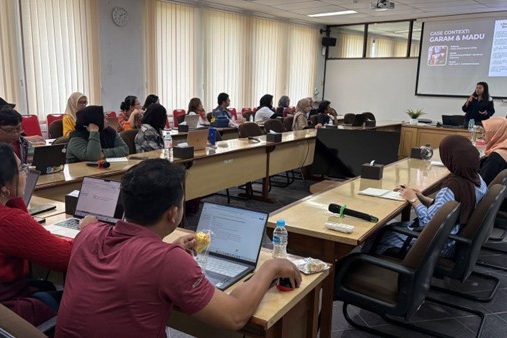
Yogyakarta, October 10th 2025 – The Media and Cultural Master Program, The Graduate School, Universitas Gadjah Mada, held a research sharing session titled “When Music Goes Viral: How Does Online Backlash Impact Garam & Madu’s Singers and Indonesia’s Policy Playbook?” featuring Aurelia Putri Rifito, S.Ikom., M.Sc., CELTA, as speaker. The event took place on Friday, October 10th 2025, from 1:00 to 4:00 p.m. in Meeting Room A, 5th Floor, Graduate School Building Unit 1, UGM.
The session was attended by students of the Media and Cultural Studies program as well as other members of the academic community interested in digital culture, creative industries, and platform governance. Through this event, participants explored the phenomenon of online virality and its impact on creative workers in Indonesia.
Aurelia Putri Rifito is a graduate of the Science in Creative Industries and Cultural Policy Master Program of University of Glasgow. In addition to her research on digital culture, she has professional experience in communication, content development, and language education, and holds a CELTA certification. Her background includes leadership in the Indonesian student community in Glasgow and involvement in creative capacity-building initiatives. Her participation in this forum was expected to bring fresh insights into the dynamics of virality and its implications for creative workers.
Aurelia, in her presentation, discussed the dynamics surrounding how music and artists can suddenly rise to fame in the digital sphere, encountering intense backlash in the form of harsh criticism, ridicule, and personal attacks. The case study focused on the singers of the song “Garam & Madu,” examining how waves of online backlash affected their exposure, career opportunities, and emotional well-being. Using a qualitative approach—semi-structured interviews with three participants and thematic analysis based on a codebook—the research offered a nuanced understanding of the social and emotional costs of instant popularity.
The study revealed a paradox of ambivalent visibility: on one hand, virality amplifies promotion and visibility; on the other, it significantly heightens psychological pressure and reputational risk. The research also highlighted the role of cultural mediation—such as norms of shame and public apology demands—which often reinforce the cycle of backlash. Artists’ coping strategies tend to be individualized, ranging from “performative resilience” and social media withdrawal to reliance on small personal support networks, while institutional support from platforms and industry stakeholders remains limited.
In response to these findings, Aurelia proposed recommendations grounded in a harm-reduction framework. At the cultural policy level, she emphasized the need for mental health support services, rapid-response hotlines for creators, and strengthened community care networks to prevent isolation. At the platform level, she called for more culturally sensitive and transparent moderation systems with accessible reporting mechanisms. At the industry level, she suggested the development of controversy-handling protocols, diversification of income sources, crisis communication support, and affordable legal assistance. All these recommendations aim to safeguard the safety, dignity, and sustainability of creative workers’ careers in the digital era.
The program, through this forum, aims to foster interdisciplinary discussions on digital culture that enrich academic discourse and strengthen policy practices in Indonesia. The active participation of attendees in the discussion and networking sessions is expected to help transform scholarly knowledge into practical efforts that protect and empower creative workers amid the challenges of online virality.
Author: Khoirul Mujazanah