
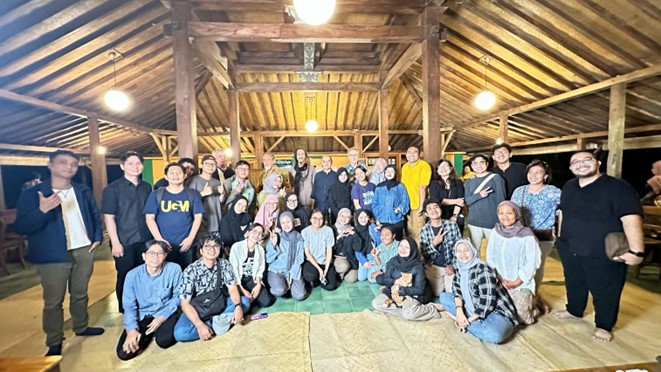

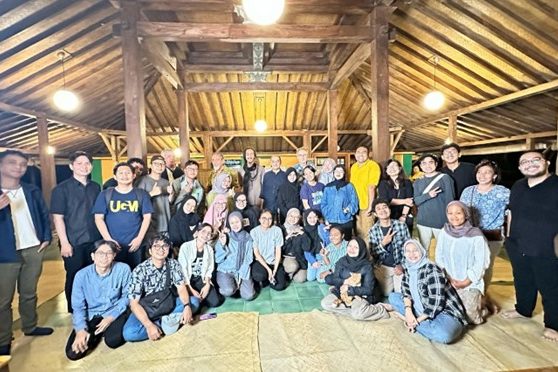
Bantul, March 11th 2025 — Master students from the Center for Religious and Cross-Cultural Studies (CRCS and ICRS), Graduate School of Universitas Gadjah Mada, participated in an educational visit to Bumi Langit Institute, a permaculture center located in the Imogiri area of Bantul, Yogyakarta.
This visit was part of the learning activities for the Religion and Ecology and Interreligious Dialogue courses. Initially, the event was conceived following an invitation from Bumi Langit to Dr. Zainal Abidin Bagir to be a guest speaker on a podcast discussing religion and the environment. The idea then evolved into a field visit involving students, warmly welcomed by the Bumi Langit team.
The students were introduced to various aspects of sustainable ecology, during the visit, including the concept of permaculture, water management, regenerative landscape systems, and the use of local plants in daily life. They also observed first-hand the eco-friendly practices implemented at Bumi Langit, such as organic waste processing and the use of renewable energy.
The program began with a guided garden tour, followed by an interactive podshow themed “Religion and the Environment,” and concluded with a communal iftar. Despite the heavy rain during the talk show, participants remained enthusiastic and engaged until the end of the event.
Novita, a student from CRCS UGM, expressed her admiration for Bumi Langit’s sustainable practices. “I saw how space was used so effectively. People at Bumi Langit can live self-sufficiently. I also learned that waste can be turned into something useful, like energy or fertilizer,” she said. She also highlighted the importance of religious communities being involved in environmental issues: “Because the environment is not separate from our religious life.”
Meanwhile, Johanes Marno Nigha from ICRS UGM offered a deep reflection on the interconnection between ecology, spirituality, and his coursework, especially in Interreligious Dialogue: Theories and Practices. He noted how Bumi Langit’s permaculture practices reflect local wisdom, such as the Subak system in Bali, which embodies collective responsibility toward nature.
“The guidance from Mas Tantra was impressive,” said Johanes. “He not only explained physical elements, but also facilitated a spiritual and reflective experience of life’s fundamental elements. I felt like I was entering a living archive—every stream of water, every layer of humus, and every energy system at Bumi Langit holds traces of knowledge and spirituality.”
He also realized how the concept of ‘simplicity’ in living harmoniously with nature can serve as a bridge to universal interfaith values. “I ate food I knew the origin of. There was a new awareness—how I’ve been living in a world that treats food merely as a commodity. At Bumi Langit, I learned that eating doesn’t always mean buying—it can mean nurturing,” he concluded.
This visit served as a meaningful encounter that enriched the students’ understanding of how religious and ecological practices can mutually reinforce one another. Through interfaith dialogue and direct experience, students were invited to understand that environmental sustainability is not only a technical issue, but also a spiritual and ethical one.
Tags : Yeti Susilowati